Topic: Permits
Published: 4 Sep 2026
Houston has no zoning. Deed restrictions are what actually stop you building
Houston is the largest US city without conventional zoning, but that does not mean a lot is unregulated. Private deed restrictions recorded against the property control use, size, setbacks and often materials, they are enforced by neighbours and by the City itself, and two lots on the same block can carry completely different rules.
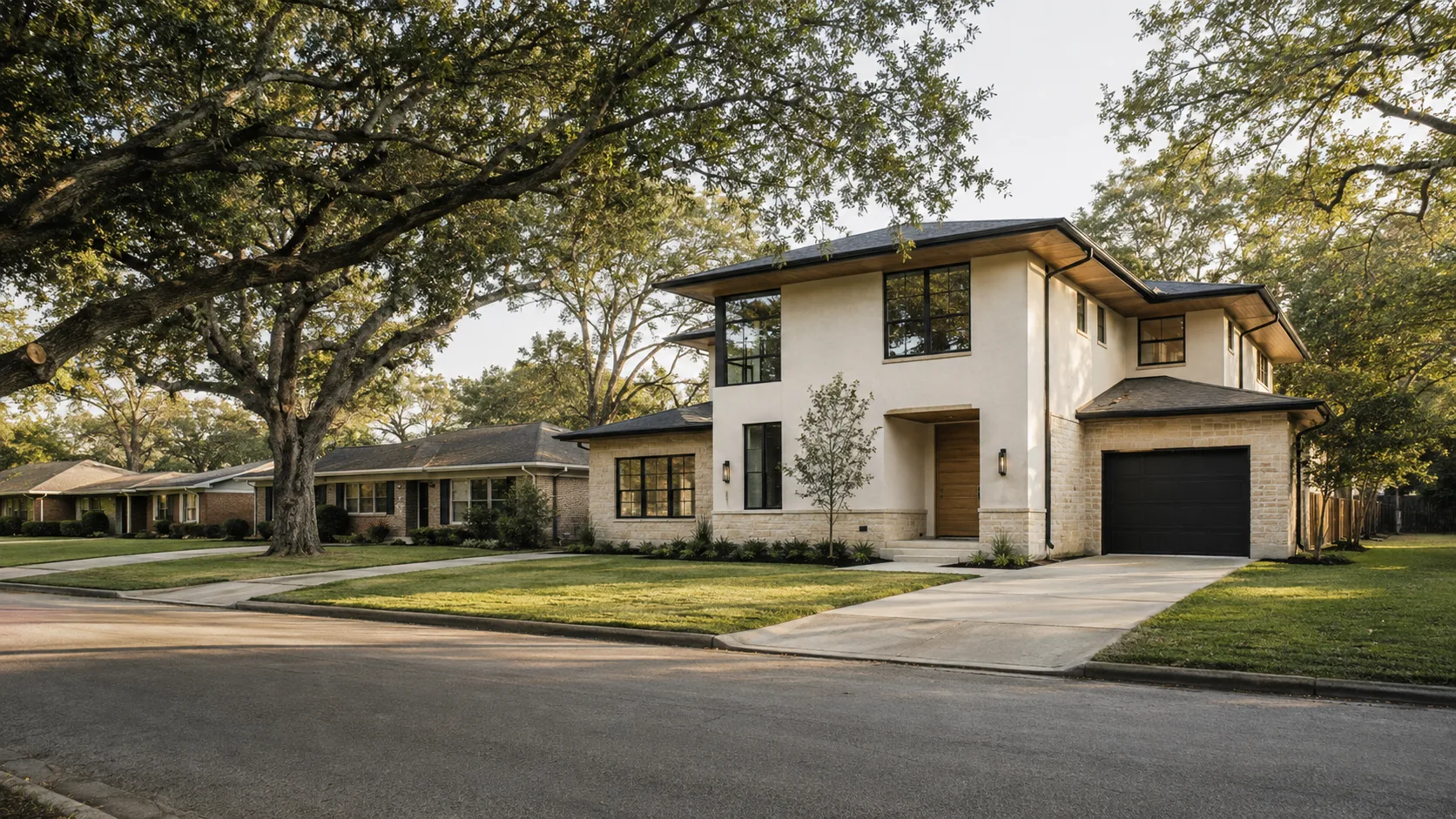
Houston does not have conventional zoning, and it is the only large American city that does not. What it has instead is a stack of private agreements recorded against individual subdivisions, called deed restrictions, and those are what will actually stop you putting a second storey on your house or a garage apartment in your back yard.
They are not city rules. They are contracts that run with the land, written by whoever platted the subdivision, sometimes in the 1920s and sometimes last year. You agreed to them when you bought the lot, whether or not you read them. And unlike zoning, they are not published on one map you can look up in an afternoon — they sit in the county real property records, one instrument per subdivision, and the lot across the street may be bound by something completely different.
That last point is the one that costs people money.
What a deed restriction typically controls
The contents vary enormously by era and by neighbourhood, but the recurring items are:
- Use. Single-family residential only is the most common clause in the metro. It is also the clause that quietly kills home-based businesses, short-term rentals and detached rental units.
- Minimum floor area. A stated square footage the main dwelling must meet or exceed. Older restrictions sometimes set a number smaller than anything anyone would build today, which makes them harmless. Some set it high, which is the point.
- Building lines and setbacks. Distances from front, side and rear property lines. These stack with the plat's own building lines and with the permitting authority's requirements, and the most restrictive one wins.
- Height or number of storeys. The clause behind a lot of failed second-storey additions.
- Outbuildings and accessory structures. Whether you can have a garage apartment at all.
- Materials and appearance. Masonry percentages, roof pitch, fence height and material, sometimes exterior colour.
- Architectural control. A committee that must approve plans before construction. In older subdivisions the committee named in the document dissolved decades ago, which raises a genuinely awkward question about who approves anything now.
Not every subdivision has all of these. Some inner-loop neighbourhoods have restrictions that lapsed and were never renewed. A few never had any.
Who enforces them, and why Houston is unusual
Deed restrictions are private covenants, so the ordinary enforcer is another owner in the same subdivision, or a civic club or HOA where one exists. Someone sues, asks a court for an injunction, and the losing side often pays the other side's attorney fees because the restriction document says so.
Houston is different in one specific way. The City of Houston will enforce private deed restrictions itself — the City Legal Department runs a deed restriction enforcement group, using authority Texas gives municipalities to sue over restrictive covenants. Practically, a neighbour who does not want to hire a lawyer can complain to the City, and the City can be the party that files.
That inverts the assumption most newcomers arrive with. People hear "no zoning" and read it as "no rules." In a deed-restricted subdivision the rules can be tighter than zoning would have been, and the enforcement can still involve the city.
Can the City of Houston really sue me over a deed restriction?
Yes. Texas authorises municipalities to enforce restrictions much as a private party could, and Houston maintains staff who do exactly that. What the City cannot do is rewrite the restriction or grant you a variance from it, because it is not a city document and there is no counter to appeal to. Confirm the current process with the City Legal Department before relying on any of this. Staffing and procedure change, and this is not a permit desk that will give you a quick reading over the phone.
Restrictions and permits are two separate gates
This is where projects get lost. The permit and the restriction are checked by different people, at different times, against different documents. Passing one tells you nothing about the other.
Depending on the address, the building permit comes from the City of Houston, from an incorporated city like Bellaire or West University Place, or from unincorporated Harris County. Which authority governs is its own question, and Modern Acre Studio's walkthrough of working out which permitting authority covers an address is the clearest version of it.
None of those authorities checks your deed restrictions as part of a residential permit review. You can hold a valid permit for a structure a court will later make you remove. That reads like a technicality until you meet someone it has happened to.
What governs a lot with no restrictions
Plenty of Houston has none. Restrictions that lapsed, subdivisions platted without them, sites assembled from several plats. That land is not unregulated either.
The City's development ordinance still sets minimum lot sizes, building lines, parking, platting and drainage. Beyond that, residents of a block can petition the City to establish a special minimum lot size area or a special minimum building line area, which locks in the existing pattern of the street. It is the closest thing Houston has to neighbours voting on the shape of their block, and it is a hard constraint on lot splits.
So if you are buying a large inner-loop lot intending to split it into three townhouse sites, whether one of those designations already covers the block is a question to answer before closing. Requirements change. Check the current ordinance rather than what the seller's agent remembers.
How to actually find yours
- Pull the title commitment from your purchase. Schedule B lists the recorded restrictions by instrument or film code number. Fastest route, and most owners already have the file.
- Search the county clerk's real property records for the subdivision name — Harris, Fort Bend, Montgomery or Brazoria, whichever the lot sits in. Restrictions are indexed by subdivision, not by street address.
- Read the amendments, not just the original. A 1948 instrument amended in 1979 and again in 2006 is 3 documents, and the rule that binds you is the combination.
- Check the term. Many older restrictions ran for a fixed period and then renew automatically in blocks of 10 or 20 years unless a stated share of owners votes them down. Texas law also gives subdivisions in the larger counties routes to extend or amend, which is how neighbourhoods with lapsed documents sometimes end up with new ones.
Do this at feasibility, before an architect draws anything. A schematic design that has to shed 400 square feet or a whole storey is not a revision. It is a restart, and you pay for it twice.
Do deed restrictions expire?
Some do. Most modern ones effectively never will, because they run in renewing terms with no end date. Older ones sometimes ran out and were never renewed, which is part of why stretches of the inner loop look the way they do. Do not assume from the age of the paper — a 1930s restriction that has been quietly auto-renewing since 1955 is fully enforceable this morning.
Where this bites hardest
Three project types run into it most often. Second-storey additions on 1950s ranch stock, because of height and floor-area clauses. Garage apartments and casitas, because of accessory-structure and single-family-use clauses. Lot splits, because of minimum lot area and frontage.
If your project is one of those, treat the restriction search as due diligence on the same footing as the survey. It costs a few hours and a small records fee.
The concession
Deed restrictions are frequently better for you than zoning would have been, and the owners who complain about them loudest are usually the ones benefiting. They are why a block of well-kept houses stays a block of well-kept houses. They are the reason the lot next door cannot become a warehouse, which in a city with no zoning is not a hypothetical.
They are also inconsistent, occasionally unenforceable, sometimes administered by a committee that has not met since 1974, and written in language nobody has revisited in 60 years. Two owners can read the same clause and reach opposite conclusions about whether a detached studio counts as a dwelling. That ambiguity gets settled by a judge, at your expense, which is a strong argument for designing well inside the line rather than litigating where the line is.
Get the documents. Read them before the drawings, not after.
Sources for the process points above: the City of Houston Legal Department publishes its deed restriction enforcement role, and recorded restrictions are held in the real property records of the Harris, Fort Bend, Montgomery and Brazoria county clerks. Restriction terms, renewal mechanics and the City's development ordinance requirements change over time — confirm current details for your own subdivision before relying on them.