Topic: Construction
Published: 21 Oct 2026
A live oak 12 feet from your Houston house: keep it, barrier it or take it out?
A big tree close to a Houston house can pull enough water out of gumbo clay to drop one side of the foundation in a dry summer, but cutting it down can lift that side instead. Most of the time the right answer is to keep the tree and manage the moisture; removal makes sense mainly when the foundation is already moving and an engineer ties it to the tree.
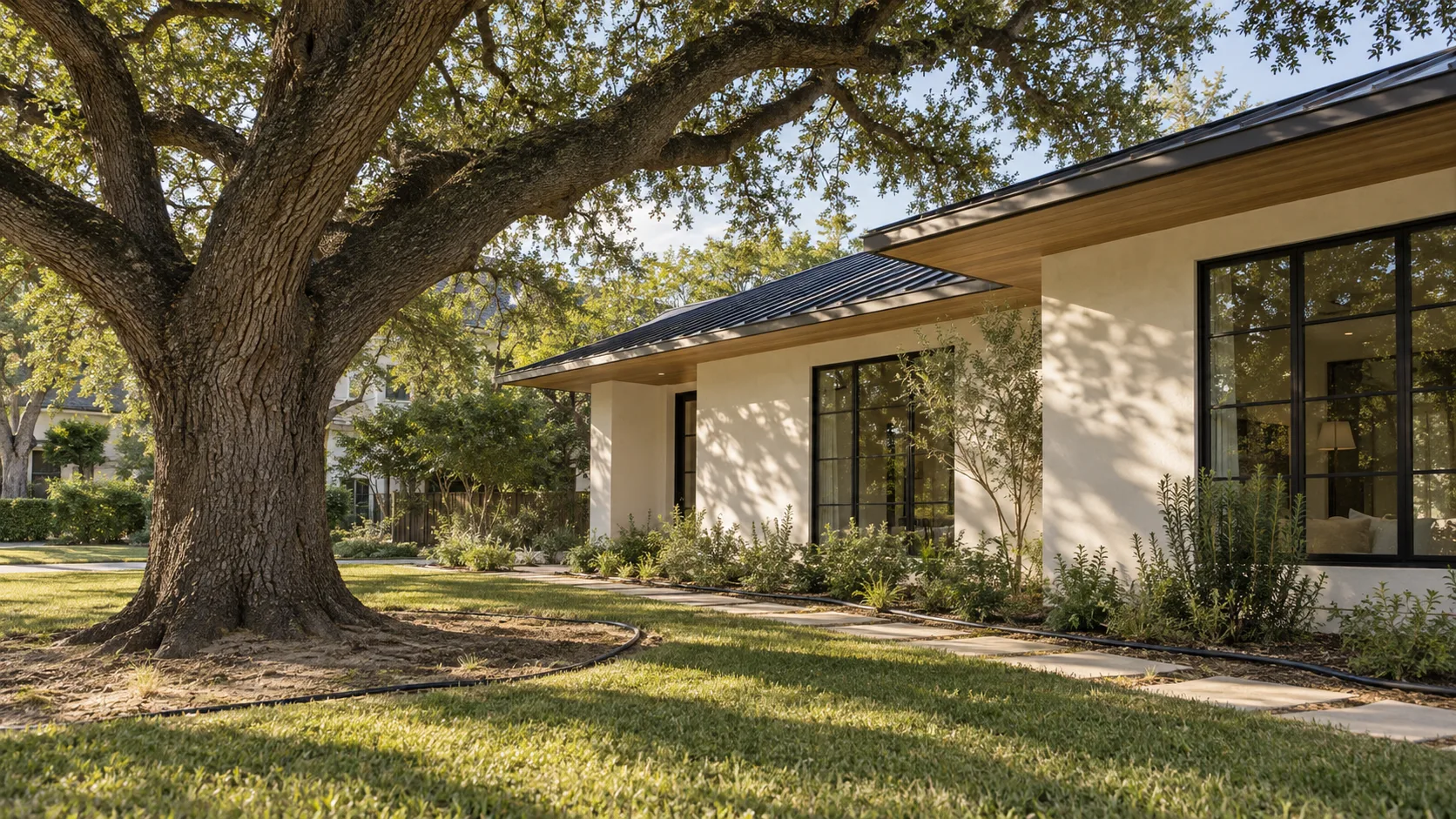
Probably keep it. A live oak within about 15 to 20 feet of a Houston slab can pull enough water out of gumbo clay in an August drought to shrink the soil on its side of the house, and the foundation follows. But cutting a big tree down next to a house can do the opposite: the soil it had been drying for 30 years drinks water back in and swells, and the same side of the house now lifts. The usual right answer is to hold the tree and manage the moisture around it. Removal makes sense when the house is already moving and a structural engineer ties that movement to the tree.
That is the short version. The long version matters because the decision is expensive in both directions, and almost everyone who makes it has been given advice from a person who profits from one answer.
What the tree does to the ground
Gumbo is expansive clay. It swells when wet and shrinks when dry, and the swing is largest in the top several feet of soil, which is where a Houston foundation sits. The clay is why houses here move at all. A tree adds a second force on top of the weather.
A mature oak is a pump. In summer it draws water from a root zone that commonly reaches out well past the edge of the canopy, and the figures usually quoted for a large tree run into the dozens of gallons a day. Rain does not refill that fast. So the soil under the tree dries out harder and deeper than soil 40 feet away, and dry gumbo shrinks.
Now put a house at one edge of that root zone. The side facing the tree sits on soil that is losing water. The far side sits on soil that is shaded by the house, covered by the slab, maybe watered by a sprinkler that the tree does not touch. One side drops. The other does not. A slab or a set of piers is built to take some of that, but it is not built to take a drop of an inch or two across 30 feet, and the first place you see it is not the foundation. It is the brick veneer cracking at a window corner, a door that sticks only in August, a gap opening where the wall meets the ceiling.
Plant roots also do not behave like the drawings. They follow moisture. A leaking sewer line or a damp bed beside the slab will attract roots the way a seam of water attracts a drill. Roots seldom crush a modern slab, but they do dry out the soil right under its edge, and in older pier-and-beam houses they sometimes wrap and shift the shallow brick or concrete piers directly.
The conventional advice, and why it only half works
The rule you hear at every nursery and from every foundation salesman is to keep trees at least as far from the house as they will grow tall. A live oak runs 50 to 60 feet. Almost no inner-loop lot in Houston has a 50-foot setback on all sides.
On a 50-by-110 lot in the Heights, Montrose or Bellaire, that rule means no trees at all. In practice the oak was here before the house. Half of the best-looking streets in the inner loop are lined with trees that sit 8 to 15 feet from a front elevation. Most of those houses are fine. Some are not.
So the rule is a risk signal, not a pass-fail test. What actually predicts trouble is a combination of four things:
- How close and how big. A 24-inch trunk at 10 feet is a different situation from a 6-inch tree at 10 feet. Species matters too, since live oak, pecan, willow and cottonwood are thirsty. Crape myrtle barely registers.
- What the soil is. Highly plastic gumbo moves a lot, and soil character changes from one part of the metro to the next. A geotechnical report states this as a number, the plasticity index, so you do not have to guess.
- What the foundation is. A well-designed post-tension slab tolerates more differential movement than an old reinforced slab. Pier-and-beam can be releveled, which is a point in its favor.
- Whether the house is already moving. A tree 10 feet from a house that has sat flat for 40 years is a tree that has been in equilibrium with that house for 40 years. That equilibrium is the thing you are about to disturb.
The fourth item is the one nobody puts on a quote.
Why cutting it down is not the safe move
This surprises owners, so it is worth saying slowly. When a big tree comes out, the ground it was drying starts to rehydrate. In Houston, where the soil is clay and the rain is heavy, that rehydration can take a year or two and push the soil up. The side of the house closest to where the tree stood can heave, and heave is harder to correct than settlement.
Heave does not always happen. It is more likely if the tree was large, close, and on that side of the house for decades, and if the soil is the high-plasticity kind. Settlement from a tree is a drying problem; heave after removal is a wetting problem. You trade one for the other and you do not get to choose the timing.
There is also the plain cost. A big live oak is the single feature that makes many Houston lots worth what they are. It is shade on the west wall in July, which is a real cooling load, and it is something a nursery cannot replace in less than a generation. Taking it out to avoid a problem you do not yet have is a poor trade.
I will concede the other side. Once the house has a diagnosed tree-driven problem, and an engineer has measured it, removal is sometimes the only fix that does not recur. Barriers and watering manage a drying tree. They do not stop a root system the size of a school bus.
The three options, in the order I would try them
Can I just water the foundation instead?
Often yes, and it is the cheapest move. A soaker hose laid in a loose curve a foot or two out from the slab edge, run on a timer, holds the perimeter moisture closer to constant. What you are managing is the swing, not the total. The point is to keep the soil on the tree side from diving while the far side stays damp.
Two cautions. Do it consistently, because a hose run for two weeks in a panic is worse than none. And put the hose out where the roots are, not tight against the slab, since water that sits against the edge of the slab can cause its own problems.
Does a root barrier work?
It can, if it is deep enough, installed correctly and sited between the tree and the house. A barrier is a vertical panel of rigid plastic or similar material set in a trench, commonly 3 to 5 feet deep, that cuts the roots running toward the house and makes the survivors turn.
It also has real limits. Cutting roots hurts the tree. A large oak that loses a big share of its structural roots on one side can go unstable in a Gulf storm, and a tree that falls on the house is a worse outcome than a cracked brick. The work should be directed by an ISA-certified arborist, not by the foundation company that installed the barrier. Barriers are also a poor fit once the trunk is within a few feet of the wall, since there is no room to dig without taking out the tree's anchoring roots. And a barrier does nothing about water uptake from roots already on the house side.
When is removal right?
When three things are true at once. A structural engineer, with no repair to sell, has measured the floor elevations and shown the house is lower on the tree side. The movement is tied to dry-season seasonal cycles, not to a plumbing leak or a drainage problem. And watering, or a barrier, has been tried or ruled out.
If you take it out, stage it. Some arborists and engineers cut a large tree down in steps or take it out in winter, when it is dormant and the soil is wettest and moving least. Others leave the stump and its roots in place to rot slowly rather than grinding them out. Neither is a guarantee. Both are better than pulling the tree and its root ball in one afternoon in August.
Check the paperwork before you pick up a chainsaw
Houston has tree rules, and the rules vary by where the lot sits. The City of Houston has protections for some trees, usually tied to development work like a new build or a lot split. Deed restrictions in some subdivisions regulate or require approval for removing large trees. The incorporated cities around Houston, Bellaire and West University Place among them, run their own permitting and may add their own tree provisions. Historic districts, including the Heights districts, can add review for changes to the front yard. I am not going to quote a diameter or a fee here, because those details change, and the safe move is to call the jurisdiction that governs the address before you hire anyone. If you are not sure which one that is, start with who actually governs the lot.
On new construction the tree is part of the design, not an afterthought. A good site plan shows the trunk and the drip line, shifts the footprint to keep the heavy roots intact, and protects the root zone during construction. Roots that were compacted by equipment or cut by a utility trench often die slowly, over several years, and owners blame the tree for being sick when the construction killed it.
What to do this month
- Look at the tree and the house together. Measure the distance from trunk to the nearest wall, and note which side of the house the doors and windows stick on.
- Check for the pattern, not a single crack. Stuck doors in August that free up in February are seasonal movement. A diagonal crack that grew across two summers deserves a call.
- Get a floor elevation survey before you accept any foundation proposal. A structural engineer who does not sell the repair will shoot relative floor heights across the whole footprint for a fraction of what a repair costs.
- Fix the water you can control first: gutters, downspout extensions, flowerbeds graded back toward the slab. If the tree is also the roof's gutter problem, the drainage fixes come first.
- Hire an ISA-certified arborist for the tree and a structural engineer for the house. Do not let one company do both jobs and sell you the answer.
What should I plant near a Houston house?
Smaller and further. Shrubs and small ornamentals like crape myrtle and yaupon holly put far less demand on the soil than an oak or a pecan, and the planting distance is a few feet, not 30. Keep the large shade trees to the side of the lot with the most room, ideally on the west or southwest side where the shade earns its keep, and at the greatest distance the lot allows. If you are choosing between a tree 25 feet from the house and one 10 feet away, the farther one costs you nothing.
Siting a house on a lot is worth a read before you lay out a new build, because the house, the shade and the big trees should be arranged together, not one after another.
Is a tree ever the reason to walk away from a house?
Rarely, but it does happen. A house with a documented history of repairs, a large oak at 6 or 8 feet, and a soils report showing high plasticity is a house you price for the future repair or skip. A house with a healthy tree at 25 feet and no cracking is a house where the tree is an asset. Ask for the repair history, ask whether any foundation warranty transfers, and ask what the previous owner watered.