Topic: Building Science
Published: 18 Nov 2026
Radiant barrier in a Houston attic: what it does, what it doesn't, and when it is worth paying for
A radiant barrier can trim cooling costs in a Houston attic, but the gain is modest and depends on where your ducts sit, how dusty the attic is and whether the roof is already doing the job. It is worth it in a vented attic with ducts, and mostly a waste over spray foam.
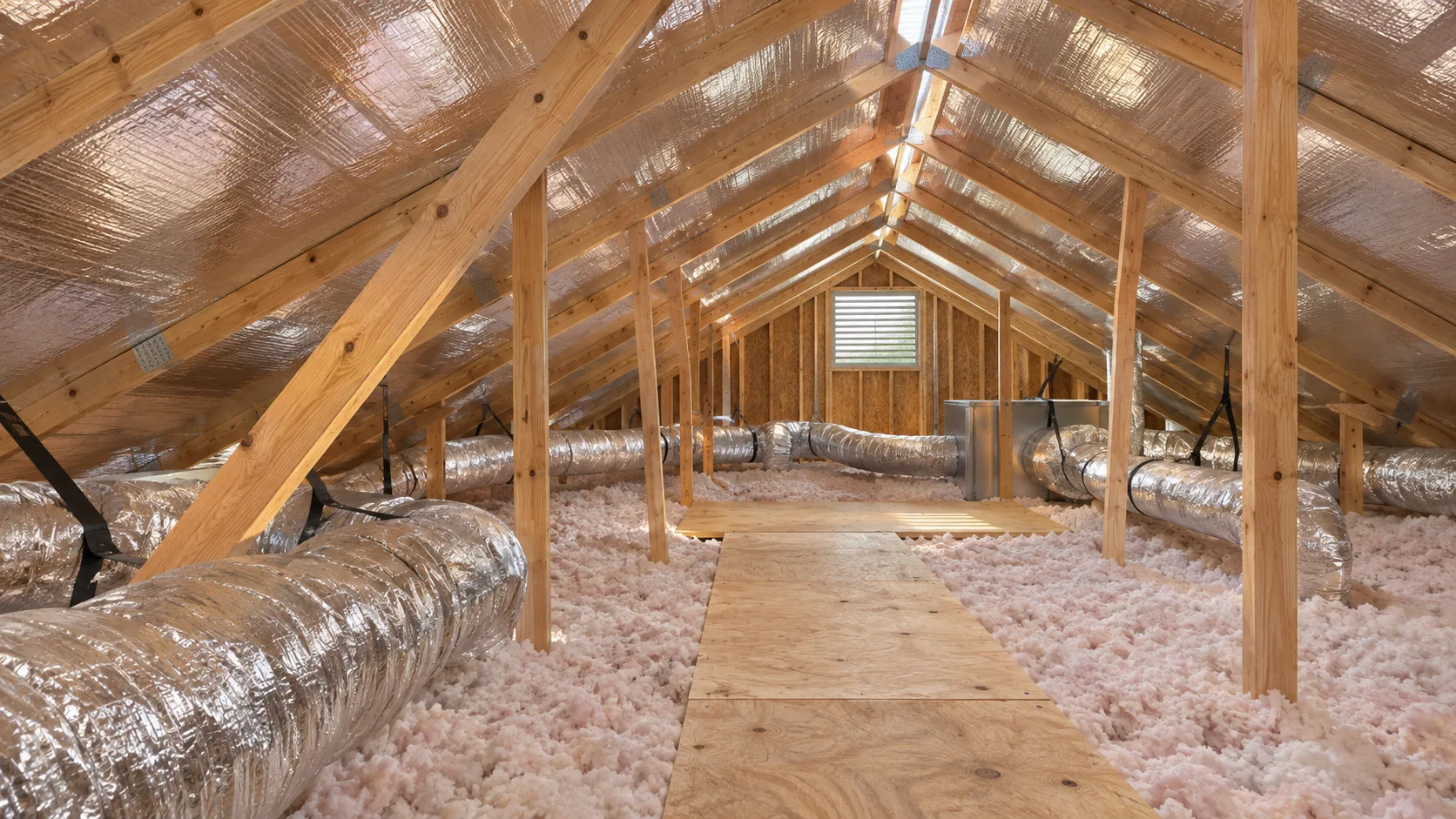
A radiant barrier is a layer of reflective foil in the attic, and in Houston it typically cuts cooling costs by a single-digit percentage. The US Department of Energy puts the figure at roughly 5% to 10% in a hot, sunny climate like ours, and the gain is largest when the air ducts run through the attic. It is a decent, cheap add-on for a vented attic with ducts. It does almost nothing in a house that already has spray foam at the roofline.
Most of the sales pitch you will hear skips that second half. A door-to-door salesperson will quote you 30% off your electric bill. That number does not survive contact with a real Houston attic.
How does a radiant barrier actually work?
Heat reaches your attic in 3 ways. Conduction moves it through solid material, convection moves it in air, and radiation sends it across empty space as infrared energy. On a July afternoon, a dark shingle roof in Houston can get hot enough that the underside of the roof deck radiates heat down toward the attic floor like a stovetop element. Fiberglass insulation on the floor slows conduction. It does a much weaker job against radiation, which is why a 130°F attic can still pour heat into the ceiling below it.
A radiant barrier is aluminum foil, usually bonded to the roof decking or stapled to the underside of the rafters. Aluminum reflects most infrared and gives off very little, so it sends that radiant heat back toward the roof instead of letting it fall onto the insulation and the ducts. The attic air still gets hot. The foil changes how much of that heat lands on the stuff you are trying to keep cool.
One detail matters more than any other. The foil has to face an air gap. Foil laid flat on top of insulation, or pressed against a surface, conducts heat like any metal and loses most of its effect. Foil on the underside of the roof deck facing down into open attic air works. Foil with a dust blanket over it does not, and that brings up the next point.
How much will it save in a Houston house?
Less than the brochure says. Here is what the numbers look like when you stop quoting the best case.
- The DOE estimate is 5% to 10% off cooling costs in hot climates, and its guidance says the benefit shrinks in homes with well-sealed, well-insulated ducts and in cooler regions.
- Research by the Florida Solar Energy Center on Florida homes, which are a fair stand-in for the Gulf Coast, found reductions that mostly landed in a similar range, with higher figures in houses that had leaky ducts in the attic.
- Houston cooling is a big share of a year's electric bill. Run the arithmetic on your own bills. Say cooling costs $2,000 a year and the barrier cuts 7% of it. That is $140 a year. A retrofit pays a crew to work across the whole roof deck from inside a hot attic, and the payback on cooling savings alone usually stretches past 15 years. Get a written quote for your roof size before deciding, because pricing moves.
Those payback numbers look bad, and they should. A retrofit radiant barrier is rarely a financial win by itself. The case for it is comfort: it can drop the attic air temperature by several degrees and the temperature of the ducts by more, and a cooler duct run means cooler air at the far bedroom register.
New construction changes the math. A radiant barrier built into the roof decking as OSB with a foil face costs a small premium per sheet, and the labor is zero because the decking has to go on anyway. Added at the framing stage, it is one of the cheapest upgrades in a new house. Added afterward, the installer has to crawl through a 140°F attic with a staple gun.
Where do the ducts run? That decides everything.
This is the question that separates a good radiant barrier job from a waste. In most Houston houses built since the 1970s, the air handler and a good portion of the ducts sit in the attic. Supply air at 55°F travels through a flexible duct in 140°F surroundings. Every foot of duct that is hot, leaky or poorly insulated costs you cooling.
If your ducts are in the attic, a radiant barrier helps twice. It lowers the radiant load on the ducts and on the insulation, and it lowers the temperature difference the ducts have to fight. If your ducts run through conditioned space, in a dropped soffit or a conditioned attic, a radiant barrier has almost nothing to reflect heat away from, and the savings fall to the low end of the range or below it.
That is the reason an old rule of thumb applies here: fix the ducts before you buy foil. A Manual J load calculation and a duct leakage test will tell you more about your cooling bill than any roof treatment. Duct leakage in older attics is commonly cited as running 20% or more of the air the system moves, and that air is dumped straight into the attic. A radiant barrier over leaking ducts is a nicer-looking way to heat a bigger attic.
Does a radiant barrier work over spray foam?
No, and this is where the sales pitch is most wrong. If you have already sprayed foam on the underside of the roof deck, you have moved the thermal boundary of the house up to the roofline. The attic is now inside the building envelope, sealed and semi-conditioned. The air in it stays near the temperature of the house, not 140°F. There is no hot attic for the foil to reflect heat out of.
Foil faces the foam directly in that setup, with no air gap, so it conducts instead of reflecting. Some contractors will still sell you a foil layer in a foamed attic. Do not buy it.
The reverse is also true. If you are choosing between a conditioned attic and a vented attic with a radiant barrier on a new build, they are two different strategies for the same problem. The conditioned attic usually performs better because it takes the ducts out of the heat entirely. It costs more to build, and it changes how the house handles humidity. Modern Acre Studio has written about how to decide between a conditioned attic and a vented one, including what happens when that upper space becomes a bonus room.
What goes wrong with radiant barriers in the field?
3 things show up often enough to plan around.
Dust. A layer of dust on the foil raises its emissivity, which is the technical way of saying it stops reflecting. Foil facing up, laid on top of the insulation, is the version that loses performance as dust settles on it, and field studies have found the loss can be large. Foil facing down from the underside of the roof deck collects far less dust, because gravity works for you. If an installer proposes laying foil across the attic floor in Houston, where the fine dust and construction debris are constant, say no.
Moisture. Houston attics see humid air, and a foil sheet is a vapor barrier. Stapled across the entire underside of the roof deck with no perforations, it can trap moisture in the sheathing and rafters. Look for a perforated product, which lets the deck breathe, or a foil-faced OSB product designed for the job. Do not use a solid, non-perforated foil on the roof deck of a vented attic without understanding where the moisture goes. This is the same reasoning behind the problem with vapor barriers in Houston walls: the wrong layer in the wrong place holds water where you do not want it.
Blocked ventilation. Foil installed carelessly can cover the soffit vents or the baffles that keep the eave airflow open. A vented attic needs the air path from the soffits up to the ridge. Block it and the attic runs hotter than before. The residential code ties the amount of vent area to the attic floor area, with a ratio commonly 1 to 150, and 1 to 300 if the vents are balanced between high and low. Confirm the adopted code edition and any local amendment with the building department that permits your address.
I will concede one thing here. Plenty of attic ventilation advice in Houston is borrowed from drier or colder places. In a hot, humid Gulf Coast climate, a lot of builders and building scientists argue that venting an attic pulls in wet outdoor air, and that sealing the roofline is the better answer. They are not wrong. The vented-attic approach works, it is cheaper, and a radiant barrier makes it better. It is not the highest-performing option.
When is a radiant barrier worth buying?
A short list, and you can check it against your own house.
- You are building new and the roof will be vented. Ask for foil-faced roof sheathing. It is one of the lowest cost-per-benefit items on the spec sheet.
- Your ducts are in a vented attic, they are already sealed and insulated, and the attic is hot enough that the upstairs rooms lag behind the downstairs ones. A retrofit may be a reasonable comfort upgrade.
- You are re-roofing anyway. If the roof deck is open or the shingles are off, installing foil-faced decking or a membrane under the new roof costs far less than a standalone retrofit. A re-roof with shingles or standing seam metal is the moment to ask.
And a short list of cases where it is not worth it.
- The attic is already conditioned with spray foam at the roofline.
- The ducts are in conditioned space.
- The ducts leak. Seal them first.
- A salesperson quotes savings above 15%. The number is not backed by the research that exists.
What should you do first, before spending on foil?
In cooling-bill terms, a radiant barrier sits near the bottom of the list for most Houston houses. The order that tends to pay off looks like this.
Seal and insulate the ducts. Right-size the air conditioner so it runs long enough to pull humidity out of the air. Look at the windows, because west-facing glass on a house with no overhang can outweigh anything the attic does; replacement windows and the cooling bill covers how much. Then add attic insulation up to the R-value the code calls for in climate zone 2A, confirming the current figure with your building department. Only then does foil start to look like a sensible next step.
If you are mid-design on a new house, this is also the cheapest time to choose. Move the ducts into conditioned space, or specify a sealed attic, and the whole question goes away. An architect can draw the mechanical chase and the dropped soffits into the plan before the framing starts, and that costs far less than any retrofit.