Topic: Building Science
Published: 30 Sep 2026
Vapor barriers in Houston walls: why the rule from up north rots houses here
A Houston exterior wall should not have plastic sheeting, foil-faced board or vinyl wallpaper on its inside face. For most of the year the moisture in a Houston wall is moving inward, from humid outdoor air toward the air-conditioned room, so a barrier on the room side becomes the surface it condenses on. The wall has to drain water on the outside and be able to dry toward the inside.
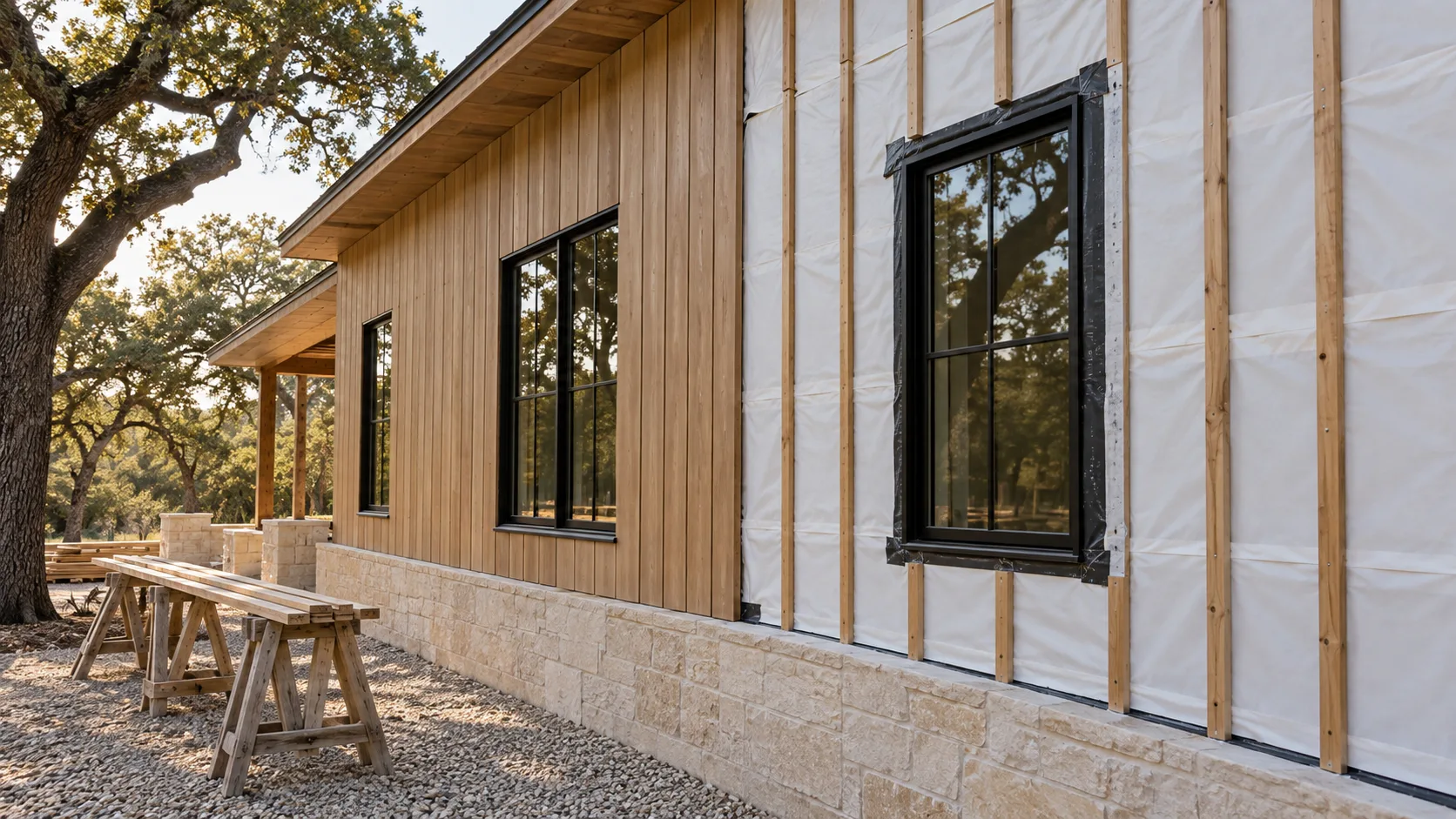
Do not put plastic sheeting, foil-faced foam board or vinyl wallpaper on the inside of an exterior wall in Houston. For most of the year the water vapor in a Houston wall is travelling inward, from humid outdoor air toward the air-conditioned room, and a barrier on the room side becomes the first cool surface it meets. That is where it condenses, out of sight, behind the drywall. A wall here has to stop and drain rain on the outside and stay open enough to dry toward the inside, where the air conditioner can take the moisture away.
That is close to the opposite of what a wall in Minneapolis needs, and a lot of the advice homeowners find online was written for Minneapolis.
Why does the direction of vapor matter so much in Houston?
Water vapor moves from warm, wet air toward cooler, drier air. In a Minnesota January the inside of the house is 70°F and humid by comparison, the outside is below zero, and vapor pushes outward through the wall. Put a vapor barrier on the warm side, the room side, and it stops that moisture before it reaches cold sheathing. That is where the rule comes from, and up there it is right.
Now run the same wall through a Houston August. The outdoor dew point sits in the low-to-mid 70s for weeks at a time. Inside, a house held at 75°F and 50% relative humidity has a dew point of about 55°F. The vapor pressure difference is enormous and it points inward, toward the conditioned room, day and night, from spring well into the fall.
Put polyethylene behind the drywall in that wall and the plastic sits at close to room temperature, 72 to 75°F. Moist air that has worked its way into the cavity through the siding, the sheathing joints and the gaps around every outlet box meets a surface at or below its dew point. It condenses on the cavity side of the plastic, runs down, and wets the bottom plate and the batts. Nobody sees it until the baseboard swells or a closet on that wall starts to smell.
Houston is in climate zone 2A. The 2 means hot. The A means moist, and the A is the letter that decides this.
Where does the plastic-behind-the-drywall habit come from?
Mostly from people and publications that learned to build somewhere colder. The residential code requires an interior vapor retarder in the colder climate zones, national building-science books and videos spend most of their pages on heating climates, and crews move. A framer who spent 10 years in Denver or Chicago before coming to Katy staples up poly because every house on those crews had it.
Texas does not license residential general contractors, as the piece on who actually regulates builders here explains, so there is no state exam that would have taught a crew otherwise. And a building inspector is checking that required items are present. An extra layer that makes the wall worse is rarely what the inspection is looking for.
Vinyl wallpaper is the other source, and it is the more common one in older houses. It is a very effective vapor barrier, glued straight to the drywall, and Gulf Coast hotels learned at great expense in the 1980s and 1990s what happens when you put it on the inside of an air-conditioned exterior wall. The paper bubbles, the paste feeds mold, and the gypsum behind it turns black.
How do you know if a wall already has the problem?
Look at the walls that stay coldest and get the least air movement. The signs are specific:
- Baseboards on exterior walls that have swollen or separated at the bottom edge, especially on the north and east sides where the sun never dries the outside.
- A musty smell in closets built against an exterior wall. Clothes and shelving block the drywall from drying into the room.
- Wallpaper on an exterior wall that has bubbled, lifted at the seams or shows brown staining.
- Mold on the back of a mirror, headboard or built-in cabinet mounted to an exterior wall.
- Drywall that reads high on a moisture meter along the bottom 12 inches of an outside wall when the interior walls read dry.
A bedroom held at 68°F overnight makes all of this worse, because a colder room means a colder wall surface. So does an oversized air conditioner, which cools the room fast and shuts off before it has pulled much water out of the air. The attic spray foam article covers why so many Houston systems end up oversized, and why re-sizing after an envelope upgrade matters.
What does a wall that works in Houston look like?
Read it from the outside in. Each layer has one job, and vapor control ends up on the outside of the wall, not the inside.
- Cladding with a gap behind it. Brick veneer needs its air space, commonly about 1 inch, clear of mortar droppings, with weep openings at the bottom so water that gets behind the brick can leave. Siding and plaster work much better over furring strips, 3/8 to 3/4 inch, which give a drainage and drying gap. This matters more here than people expect. Brick, stone and traditional stucco soak up rain, and the next morning the sun heats the wet face and drives that moisture inward. Without a gap it goes straight into the sheathing.
- A water-resistive barrier, lapped like shingles. Housewrap or a fluid-applied membrane, with the upper piece always over the lower one. The window openings are where this layer is won or lost. A wall with perfect wrap and a badly flashed window sill will rot under the window.
- Sheathing, and sometimes exterior insulation. A layer of rigid foam on the outside of the sheathing is a sound choice in Houston precisely because it is on the humid side. It keeps the sheathing closer to outdoor temperature and blocks vapor where the vapor comes from.
- Cavity insulation that breathes. Unfaced fiberglass, mineral wool or dense-packed cellulose. Kraft-faced batts are tolerable; the paper facing becomes more permeable as it gets damp.
- Drywall and latex paint. Ordinary latex paint lets vapor through, so the wall can give up whatever moisture it collects into the air-conditioned room, where the system removes it.
The code sorts vapor retarders into 3 classes by how much vapor they let through, measured in perms. Class I is 0.1 perm or less: polyethylene, foil, vinyl wallpaper. Class II runs from 0.1 to 1.0: kraft facing and vapor-retarder paints. Class III runs from 1 to 10, and ordinary latex paint on drywall lands there. In a Houston exterior wall you want the room side in Class III.
Modern Acre Studio has written a longer piece on how humidity shapes the envelope, air and materials of a Houston custom home, which comes at the same problem from the design side and is worth reading alongside this one.
Is closed-cell spray foam in the walls a vapor barrier problem?
Partly, and this is where competent Houston builders disagree.
About 2 inches of closed-cell foam is a Class II vapor retarder, and because it is sprayed directly onto the back of the sheathing there is no air gap for moisture to condense in. In that narrow sense it behaves well. The objection is what happens when water gets in from the outside through a leaking window or a failed flashing. Closed-cell foam does not let the sheathing dry in either direction, so the leak can sit against wet plywood for a long time before anyone knows.
Open-cell foam is vapor-open and dries more easily, but it holds water like a sponge if the exterior leaks, and it is harder to inspect. Neither foam fixes a bad drainage plane. If you pay for foam in the walls, pay first for the flashing at every window and door, and ask to see it before the foam covers it.
What changes on a remodel of an older inner-loop house?
A 1920s or 1930s pier-and-beam bungalow in the Heights, Woodland Heights or Norhill usually has board sheathing, no insulation in the walls and no vapor barrier at all. It has lasted a century because it leaks air freely and dries in every direction. Summer inside was not much drier than summer outside.
Insulating those walls and adding modern air conditioning changes the physics. The wall now has a cold interior face for 8 or 9 months of the year and far less air moving through it. Blowing cellulose into the cavities and leaving the interior finish vapor-open is generally the safer route. Adding poly when the walls are open for rewiring is the worst route, and it is common, because the electrician or drywall crew thinks they are doing you a favor.
The same care applies after a flood. Houses that took water in Harvey in August 2017 were typically gutted with a flood cut 2 or 4 feet up the wall. Rebuilding that lower section with a plastic layer behind new drywall, or with vinyl wallcovering in a bathroom on an exterior wall, recreates the hidden-condensation problem in the part of the wall most likely to get wet again. If the house sits in a mapped floodplain, the floodplain article covers the elevation and permitting side of rebuilding.
If the choice between patching and starting over is still open, the remodel-or-rebuild piece is where to start. A new wall assembly is one of the few things a rebuild gets you that a remodel struggles to.
Did the February 2021 freeze change any of this?
No. During Winter Storm Uri in February 2021 the vapor drive in Houston walls did reverse for a few days, outward toward the cold sheathing, the way it does in Minnesota all winter. A few days is not long enough to load a vapor-open wall with meaningful moisture, and it dries out again within days of the weather turning. The freeze damage people remember was burst pipes and failed equipment, which the post-Uri freeze-proofing article covers. Designing Houston walls for a 4-day event at the cost of the rest of the year gets the priorities backward.
Where does the rule bend?
In 2 places, and a third where the honest answer is that it depends.
A room that is humid on the inside all year runs the vapor drive the other way. A steam shower, a room with an indoor pool, a sauna, or a steam-heavy scullery all push moisture outward into the wall, and those rooms do need a real vapor barrier on the room side, detailed carefully at every penetration. That is not an exception to the physics. It is the same physics with the wet side moved indoors.
The second is that a great many Houston houses built with poly behind the drywall have not rotted. Walls that leak enough air, sit under deep overhangs, face south and get sun, or have well-sized air conditioners often survive a bad assembly for decades. If your house has plastic in the walls and every wall reads dry, do not tear out sound drywall to remove it. Fix it when the walls are open anyway.
And the exterior insulation question has no single right answer. Rigid foam outside the sheathing costs real money, it complicates window and trim details, and some experienced Houston builders would rather put that money into a better drainage gap and better flashing. That is a defensible choice, and on a tight budget it is often the smarter one. Run both versions through the cost calculator before deciding.
What should the drawings say, and what should you ask?
The drawing set should include a wall section that shows every layer from cladding to paint, with each material named. If you want to know what else belongs in a complete set, the drawing set breakdown walks through it. A wall section that just says "per code" or "insulation as required" leaves the vapor decision to whoever shows up with a staple gun.
Before the framing inspection, put 4 questions to your architect or builder:
- What goes on the inside face of the exterior walls behind the drywall? The answer that should worry you is "plastic, it keeps the moisture out."
- Where is the drainage plane, and how does water behind the cladding get out at the bottom?
- How are the window sills flashed, and can I see it before the cladding goes on?
- What is behind the brick, how wide is the air space, and who keeps it clear of mortar?
An architect who has worked through a few Houston summers will answer all 4 without looking anything up. If you are still choosing one, the Houston architecture firm register lists firms by the kind of work they do.