Topic: Building Science
Published: 23 Sep 2026
Freeze-proofing a Houston house: what Winter Storm Uri showed about where the pipes are
Most Houston houses that flooded from inside in February 2021 did not fail because of cold alone. They failed because water lines ran through places that were never meant to be heated, like vented attics, exterior walls, crawlspaces and outdoor equipment, and then the power went out. Move or protect those lines, know where your main shutoff is, and plan how the house stays above freezing without the grid.
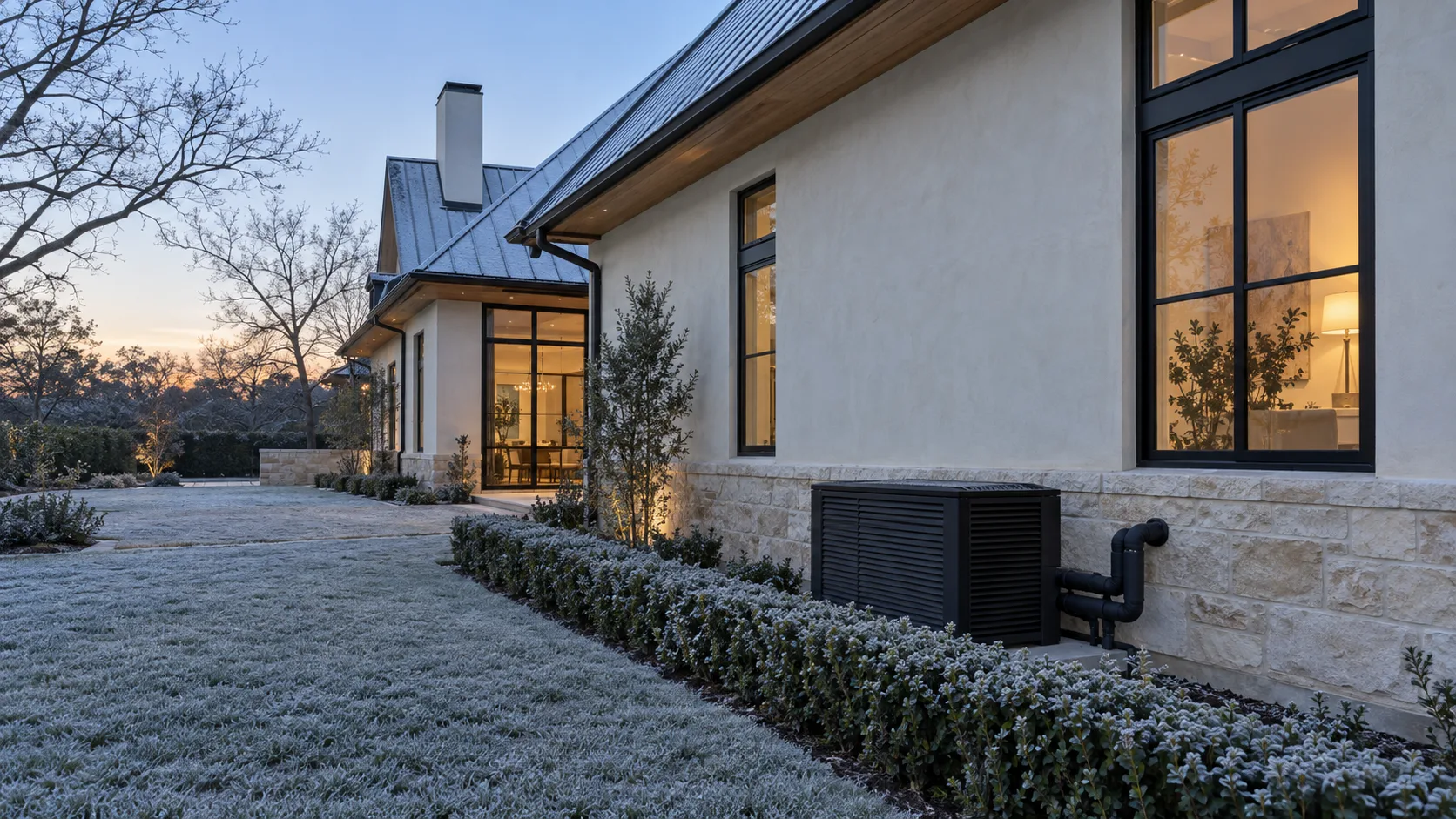
Most Houston houses that flooded from the inside in February 2021 did not fail because it got cold. They failed because water lines ran through places the house was never heating, like vented attics, exterior walls, crawlspaces and outdoor equipment, and then the power went out for long enough that the heated places stopped being heated too. Freeze-proofing here means moving or protecting those lines, knowing exactly where to shut the water off, and deciding how the house stays above 32°F without the grid.
That is a shorter list than most freeze-prep advice suggests. It is also more expensive, because the useful items are about where pipes run, not what you wrap them in.
Why did Houston houses fail so badly during Uri?
Because the region builds for heat, and it builds sensibly for heat.
Houston is climate zone 2A, hot and humid, and nearly every design choice in a typical house points the same way: get the heat out, keep the damp out, keep the air conditioner happy. Northern builders keep water lines out of exterior walls as a matter of habit, because a pipe in an exterior wall in Minneapolis is a pipe that will freeze in its first January. Houston builders have had little reason to. A hard freeze here arrives every few years and usually lasts a night. Uri held the region at or below freezing for days, with overnight lows in the teens, and at the same time the state grid shed load and a very large share of Houston homes lost power.
The combination is what did the damage. A house with power and a working furnace can usually keep an interior pipe above freezing even at 15°F. A house with no power for 3 days cannot keep anything warm, and every line on the outside of the building envelope, or outside it altogether, froze first and split.
Most of the splits did not show up until the thaw. A frozen line is plugged with ice. When it thaws, water finds the split at full pressure, and if nobody is home, or nobody knows where the shutoff is, a split in a second-floor wall can run for hours.
Where do the pipes actually run in a Houston house?
That depends heavily on the foundation, and the foundation depends on when and where the house was built.
Slab houses. Most houses built in the last few decades in the region sit on a post-tension slab, because gumbo clay moves too much for much else. Water lines in a slab house either run under or through the slab, which is protected by the ground, or overhead through the attic and down the walls. The overhead route is common. It is cheaper to install, and it is the only practical route for most later additions and remodels, because cutting a post-tension slab to add a line is expensive and has to be done carefully. The piece on gumbo clay and Houston foundations covers why. The consequence is that in a lot of slab houses, the water supply spends a long stretch of its run in a vented attic, which in a freeze is outdoors.
Pier-and-beam houses. Much of the pre-1950s inner-loop housing stock, in the Heights, Woodland Heights, Norhill and parts of Montrose, sits on piers with a crawlspace under the floor. The supply and drain lines run through that crawlspace, open to the wind under skirting that was designed to ventilate, not insulate. These are the most exposed pipes in the city. Crawlspace plumbing in an old Heights bungalow is essentially outdoor plumbing with a floor over it.
Exterior walls. In both types, fixtures often sit on outside walls. Kitchen sinks under windows are the classic case, and so are bathroom vanities on the back wall and laundry boxes on the garage wall. A supply line inside an insulated exterior wall is fine as long as the room behind it is heated. When the heat goes off, that line is a few inches of fiberglass away from the weather.
Garages. Water heaters, laundry and sometimes the whole water entry sit in an unheated attached garage. Garages are cold rooms in any freeze.
What should you change in an existing house?
In rough order of value for the money:
Find the main shutoff and make it usable. This costs almost nothing and would have saved more ceiling drywall in 2021 than any other item on this list. In many Houston houses the city shutoff is in a meter box near the street, sometimes buried under grass or mulch, and needs a meter key to turn. The house-side valve, if there is one, may be an old gate valve that has not moved in 20 years and will break when forced. Replace it with a quarter-turn ball valve in a place everyone in the house can reach, and label it. Buy the meter key and keep it where you can find it in the dark.
Get attic supply lines out of the attic or into the conditioned envelope. There are 2 ways to do it. Reroute the lines down through interior walls, or bring the attic inside the house by sealing and insulating the underside of the roof deck. The second is a bigger project, with its own consequences for the air conditioner and any gas appliances up there, which are covered in the piece on spray foam in an existing Houston attic. Wrapping attic lines in foam sleeves is not a substitute. Pipe insulation slows heat loss; it does not add heat. In a long outage a wrapped pipe in a cold attic freezes a few hours later than an unwrapped one.
Close up and protect the crawlspace on a pier-and-beam house. Insulate the supply lines under the floor with fitted, taped insulation rather than loose sleeves, and pay attention to the stretch where the line comes up out of the ground and into the house, which is the coldest point on the run. Removable skirting panels that can be closed up in a freeze warning help. Heat tape on the most exposed runs is common, but it needs power, which is the thing that went missing in 2021.
Replace the hose bibbs. Frost-free sillcocks put the actual valve 6 to 12 inches inside the wall, where it is warmer. They only work if the hose is disconnected, because a connected hose traps water in the part of the bib that is outside. That is a free habit and a cheap part.
Deal with the outdoor equipment. This is the category that surprised most people, and it gets its own section below.
None of this requires a permit in the usual case, though rerouting supply lines is plumbing work, and in Texas plumbers are state-licensed even though general contractors are not. The article on Texas general contractor licensing explains the gap. The plumber pulls the permit, if one is needed, in whichever jurisdiction governs your address.
What about the tankless water heater, the irrigation and the pool?
A lot of Houston houses have expensive water-carrying equipment sitting outside the building entirely, because in a hot climate that is a reasonable place for it.
Outdoor tankless water heaters. Many are mounted on an exterior wall. They carry their own electric freeze protection, small heaters that keep the heat exchanger above freezing. That protection needs power. With the power out, the unit is a small box of water hanging on the side of the house. Manufacturers publish a drain-down procedure for a freeze with no power; the owner needs to know it before the storm, and the drain valves need to be installed and reachable. The pipes feeding the heater are usually less protected than the heater itself.
Irrigation backflow preventers. Where irrigation is required to have backflow protection, the assembly usually sits above ground near the house, a set of brass valves on 2 short vertical risers. It is about the most freeze-exposed piece of plumbing on the property. In 2021 a great many of them split. An insulated cover helps. Shutting the irrigation isolation valve and draining the assembly before a hard freeze is better.
Pool equipment. Pool pumps usually run in freeze-protection mode, circulating water so it cannot freeze in the lines. That also needs power. A pool that stops circulating for days in the teens can crack pump housings, filters and heater cores. There is not much an owner can do in a long outage besides drain the equipment pad. That is worth knowing in advance, and it argues for grouping the equipment compactly so draining it is realistic.
Exterior condensate and drain lines rarely matter. They are usually empty.
How should a new house or a full remodel handle it?
On a new house the answer is simple and costs very little: keep water out of cold places from the first sketch.
That means supply lines routed through interior walls, not exterior ones, wherever the fixture plan allows. Kitchen sinks under windows are fine, but the supply can drop from an interior wall or from below rather than rising inside the exterior wall. It means no supply lines in a vented attic. If the design has a vented attic, the plumbing stays below the ceiling. If the design uses a conditioned attic, lines up there are indoors. It means the water entry and main shutoff sit inside the conditioned house, in a known place, with a ball valve at hand height. And it means outdoor equipment is sited where it can be drained easily, with a plan written down.
A central manifold is worth considering too, with each fixture fed by its own home run from one panel. In a freeze or a leak you can shut off a single branch rather than the whole house.
A good architect coordinates these routes on the drawings rather than leaving them to whoever roughs in the plumbing. It is one of the quieter things that separates a detailed set of construction documents from a permit set; our piece on what is in an architect's drawing set describes the difference. For the wider version of this problem, power, water and envelope planned together, Modern Acre Studio has written up how a storm-resilient Texas custom home is designed.
Should you buy a generator for a freeze?
Sometimes. This is where honest advice gets less tidy.
A permanent standby generator on natural gas is the only thing on this list that keeps the whole house running through a multi-day outage. It keeps the furnace, the tankless heater's freeze protection, the pool pump and the refrigerator all working, and it also covers the more common Houston outage, the one after a hurricane in August. It is also a large purchase, it needs space, a permit and a gas line sized for it, and it needs maintenance and regular test runs that owners often skip. If the gas supply itself is disrupted, which was a real concern in 2021, it stops too.
A heat pump helps in a normal freeze and does nothing without power. Most heat pumps lose capacity as it gets colder and rely on electric resistance backup below a certain temperature, which pulls a lot of current. That matters if you are sizing a generator to carry it.
A gas fireplace or a wood fireplace keeps 1 or 2 rooms livable. It will not keep a crawlspace or an attic above freezing.
The honest ranking for most existing houses: fix the shutoff, move the attic lines, protect the crawlspace, and learn to drain the outdoor equipment first. Those handle the failure modes that actually flooded houses. A generator is a comfort and continuity decision layered on top. It is worth it for some households, particularly with elderly or medically dependent people at home, and hard to justify purely as freeze protection.
Is any of this worth it for a freeze that comes once a decade?
The concession: for many Houston houses, not all of it.
A slab house with its plumbing mostly in interior walls, a conditioned attic and nothing water-bearing outside except 2 hose bibbs came through 2021 fine, and its owners do not need to spend anything beyond the shutoff valve. Hard freezes remain rare here. Building a Houston house like a Minnesota house, with heavy insulation around every pipe and heat tape everywhere, is money spent on the wrong risk. Heat and humidity cost Houston owners far more every year than cold does.
The houses that should act are the ones with a known weakness. That means pier-and-beam houses with open crawlspaces, slab houses with the supply run through a vented attic, and anyone with an outdoor tankless heater, an above-ground backflow preventer or a pool. For those houses, a single sustained freeze with an outage can cost more in drywall, flooring and cabinetry than every item above put together. And unlike a hurricane, which gives several days of warning and a clear list of things to do, a freeze causes most of its damage after it ends, when the ice melts and the water finds the split.
If you are about to remodel, the incremental cost is the argument. Rerouting a supply line while the walls are open is a small line item. Doing it later means opening them again.
The article on whether to remodel or tear down and rebuild covers the larger version of that question. If you want someone to look at where the water actually runs in your house, the register of Houston architecture firms lists practices that do residential work.