Topic: Building Science
Published: 16 Oct 2026
Planning a Houston house for a week without power
Most Houston houses do not need a whole-house generator to get through a multi-day outage. They need a tight, shaded envelope that holds its temperature, a short list of circuits worth backing up, and a fuel source that survives a storm. Decide those 3 things on paper before you shop for a generator, because the generator is the easy part.
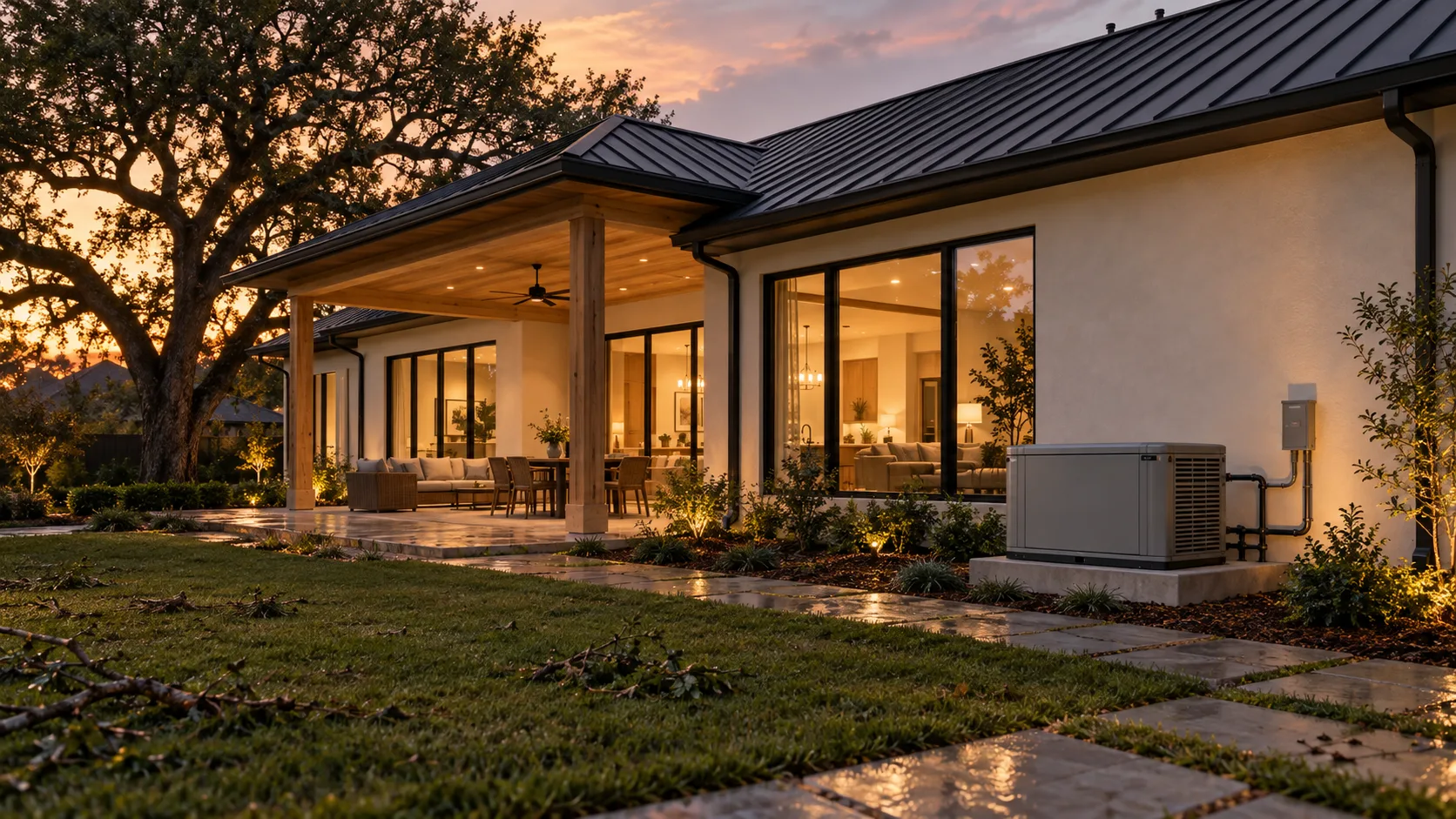
Most Houston houses do not need a whole-house generator to get through a multi-day outage. They need 3 things decided on paper before anyone shops for one: an envelope that holds its temperature, a short list of circuits worth keeping alive, and a fuel supply that still works when the storm has passed. A generator without those 3 is an expensive way to run an air conditioner that is too big for the house, in a house that cannot hold the cold you make.
That is the lesson of 2 very different events. February 2021 (Uri) was a cold-weather failure that burst pipes across the region. Hurricane Beryl in July 2024 was the opposite: a large share of the metro lost power for days in July heat and humidity, in houses built on the assumption that the grid would be back by dinner. Both found the same weakness. The house had no plan for itself.
Why does an outage hurt a Houston house more than an Ohio one?
Because the house stops being a house and becomes a box in climate zone 2A. Hot and humid means the damage from an outage is not only discomfort. With the air conditioning off, indoor humidity climbs toward outdoor humidity within a day or so, and a closed house in a Houston July is a mold incubator on every cool surface, such as the backs of closets, the inside of exterior walls and the ductwork. Mold at that scale is a restoration bill, not an inconvenience.
Heat is the other half. A house with a dark roof, a west wall of glass and an uninsulated attic climbs past comfort in hours. A house that was designed with shade and a good envelope climbs slowly, and that difference of several hours matters more than any equipment you add later. On a 3-day outage it is often the difference between a house you can stay in and a house you cannot.
There is a safety side that the building does not fix: the elderly, infants and anyone on powered medical equipment are not helped by a well-built envelope. If someone in your house depends on electricity to stay safe, that person's needs set the whole plan, and this article is the starting point rather than the answer.
What should the house itself do before any equipment arrives?
Think of it as buying time. The longer the house takes to heat up, the less power you need to hold it, and the smaller and cheaper any backup system gets. The things that buy time, roughly in order of what they are worth:
- Shade on the west and south glass. Deep overhangs, a covered patio, screens or exterior shades. Sun that never reaches the glass never has to be removed by the air conditioner. This is the single cheapest hour you can buy.
- A tight, well-insulated attic. Many Houston houses now use a conditioned attic with spray foam on the roof deck, which keeps the attic far closer to the temperature of the house than a vented attic does. A spray-foam attic does not remove heat, but it stops the roof from cooking the ceiling below.
- Light roof color and good windows. Low-solar-gain glass on the sunny faces earns its premium in precisely this situation.
- Ceiling fans in every main room, and operable windows placed to move air. A fan draws a fraction of what an air conditioner does and makes a hot room livable. Windows on opposite sides of a room give you cross-ventilation when it is safe to open them. Houston nights in July seldom drop low enough to cool a house, so treat ventilation as relief, not a fix.
- A house that was not oversized for its cooling. This one surprises people. A properly sized system is cheaper to back up, and an oversized HVAC unit that short-cycles is the reason a generator quote comes back so large.
Modern Acre Studio has a longer piece on passive cooling strategies for Houston homes if you want the design side in more depth.
Which circuits are worth backing up?
Fewer than you think. This is where most of the savings are, and it is a design decision, not a shopping decision.
Write a list, in 3 tiers:
- Must have. The refrigerator and freezer, a few lights, phone charging, the internet router, and any medical equipment. This tier is small, well under what a single circuit panel can carry, and a portable generator or a battery can cover it.
- Strongly want. One or 2 rooms' worth of cooling, either a window unit or one zone of the main system, plus a fan or 2. This is what turns a survivable outage into a livable one.
- Nice. Everything else, such as the second air-conditioning zone, the electric range, the pool pump, the dryer, the electric tankless water heater, and the EV charger.
Most owners find that tiers 1 and 2 are all they will actually use. The jump from tier 2 to tier 3 is where a generator goes from a few thousand dollars to a very large number, and a house that tries to run everything through an outage is mostly paying to feel normal.
The air conditioner is the load that decides everything. A central compressor draws several times its running current for a moment at startup, and the generator has to be able to take that hit. A unit that is a little too small may run the lights fine and trip the moment the compressor starts. Ask whoever sizes the system to size it around the startup load of the specific equipment in your house, not around a rule of thumb.
Whole-house standby generator, portable generator, or batteries?
Each is the right answer for somebody, and the honest comparison is closer than the sales material makes it sound.
Standby generator. A permanently installed unit on a pad outside, wired through a transfer switch so it starts by itself when the power drops. Residential units run from roughly 10 kW to 26 kW for the common sizes. It is the only option that works while you are away or asleep, and the only one that needs no daily effort. It is also the most expensive, it needs a fuel connection, and it needs yearly maintenance like any engine.
Portable generator. Cheap to buy, usable for tier 1 and sometimes tier 2, and it must be hand-started, fueled and managed for days. It also has the worst safety record. Carbon monoxide poisoning after Gulf storms is a recurring, preventable death, and almost always involves a generator run in a garage, on a porch or near an open window. Federal safety guidance is to run one outdoors and at least 20 feet from the house, with the exhaust pointed away. A portable generator is also not something to plug into a wall outlet through a homemade cord, which can send power back out the line and injure a utility worker. If you want to power the house itself, it needs an inlet and a transfer switch, installed properly.
Battery storage. Quiet, no exhaust, no fuel, and it can run indoors-adjacent. The limit is capacity. A battery that carries tier 1 comfortably for days can carry one air-conditioning zone for only a few hours, and without solar to recharge it between days, it is a bridge, not a solution. Paired with solar it changes the picture, and that is a separate conversation.
My own pick for most inner-loop houses with a tight envelope and one or 2 people who need to stay: a small battery or a portable unit for tier 1 and a plan to keep the house shaded, with a standby generator only when someone in the house depends on power or when the family expects to be in the house, not away, for the whole event. For a larger suburban house where the owners plan to ride out a storm at home and the A/C runs for 6 months of the year, a standby unit is worth it. I would not put one in a rental or a weekend house.
What fuel will actually be there?
This is the question most people skip, and it is where plans fail.
Natural gas is convenient, effectively unlimited, and does not need refilling. It also depends on the gas utility, which is more resilient than the electric grid but not immune, and in a flood a damaged gas line is a hazard. It requires a gas line to the pad and a licensed installation.
Propane is stored on site in a tank. It can run for days without a utility, and it is the usual answer on a rural or unincorporated Harris County lot with no gas service. Its weakness is flooding. An empty or partly full propane tank on a lot that takes water can float, and a displaced tank is dangerous. Tanks in or near a mapped floodplain need anchoring and a hard look at where they sit.
Gasoline and diesel are what portable units and some larger sets burn. Both go stale, both need storing safely, and both become hard to buy when every station nearby has the same problem and no power to run its pumps.
Whatever you choose, think about where the equipment sits. A standby generator on a pad should sit above the flood elevation for the lot, not just above the grass, because a generator that drowns during the storm that caused the outage is a very expensive lawn ornament. In a Houston neighborhood that never floods, that means a pad a few inches up. On a lot that has taken water, it means a raised platform, and you should confirm the elevation with the floodplain office rather than guessing.
Who is allowed to install it, and what does it need?
A real standby installation touches 3 trades, and Texas licenses 2 of them. Electricians and plumbers are state licensed; general contractors are not, as the article on who licenses Texas contractors lays out. The transfer switch and the connection to your panel are electrical work, and the gas piping is plumbing or gas-fitter work. The person who sells you the generator may or may not hold those licenses, so ask who actually does the wiring and who actually pulls the permit.
Most jurisdictions want a permit, and many want an inspection of the electrical connection and the gas line. Which authority governs your address changes the process, and that question has its own article. Setback and clearance rules apply too: a generator has to sit a distance from windows, doors and air intakes, and the distance comes from the manufacturer's instructions and the adopted code, not from a general rule. Neighborhood deed restrictions may also say something about where a unit can go and how loud it can be, and some master-planned communities require approval for exterior equipment.
One more thing the quote should not skip: noise. A generator running for 3 days is a long time to live beside a bedroom window, or a neighbor's. The enclosure rating and the distance from the property line are worth asking about before the pad is poured.
If I am building new, what changes?
Plenty, and most of it costs little at the design stage.
Put the generator pad, the gas stub and the transfer switch location on the drawings, even if you do not buy the unit now. Running conduit while the walls are open costs a small amount; running it afterward costs a lot more. Design the electrical panel with a separate emergency-loads panel or reserved space for one, so the circuits in tiers 1 and 2 are already grouped together. Put the router, the modem and a charging shelf on one of those circuits. Plan where a window unit could go if the main system is down.
The electrical plan is where this gets decided, and it is far cheaper to decide it on paper. If you are heading toward a larger project, the person drawing the house can lay this out alongside the rest of the set, including where the equipment sits relative to the flood elevation and the neighbors.
Will any of this stop me from needing to leave?
No, and it is worth saying plainly. Some outages are long enough, and some storms dangerous enough, that the right decision is to leave, and a generator on the patio does not change that. The plan here is for the 2 to 5 day outage after a storm has passed, not for a house in the path of a surge or an evacuation order. If officials tell your zone to go, go. Back up the freezer to a cooler, shut off the main breaker if the water is coming, and leave the gas and the equipment for after.
The concession on the other side: a good envelope and a shaded house will not make a Houston July outage comfortable. At 95 degrees outside and 80% humidity, even a well-built house will be warm, damp and unpleasant by day 3. The aim is not comfort. It is keeping the house safe, the food cold, the phone charged and the mold from starting while the lines get fixed.
What is the order of operations?
- Write the 3-tier list. It takes an hour and it is the whole design.
- Fix the envelope before the equipment. Shade, attic, glass, fans. Each hour of coolness you add is an hour of generator you do not have to buy.
- Decide the fuel. Gas line, propane tank or neither, with the flood elevation in mind.
- Get licensed trades and a permit. Ask who does the electrical and gas work by name.
- Test it. Run the generator under load once a year, and a transfer switch exercise now and then. Most failures in the first real outage are equipment that was never started in a year.