Topic: Remodeling
Published: 6 Nov 2026
Rewiring an older Houston house: knob-and-tube, aluminum and the panel
Not every older Houston house needs a full rewire. A 1930s to 1950s house with knob-and-tube needs it replaced before insulation or a remodel goes in. A 1965 to 1973 house with aluminum branch wiring needs it repaired or replaced at the connections. Most others need a new panel and a handful of circuits. Here is how to tell which house you have.
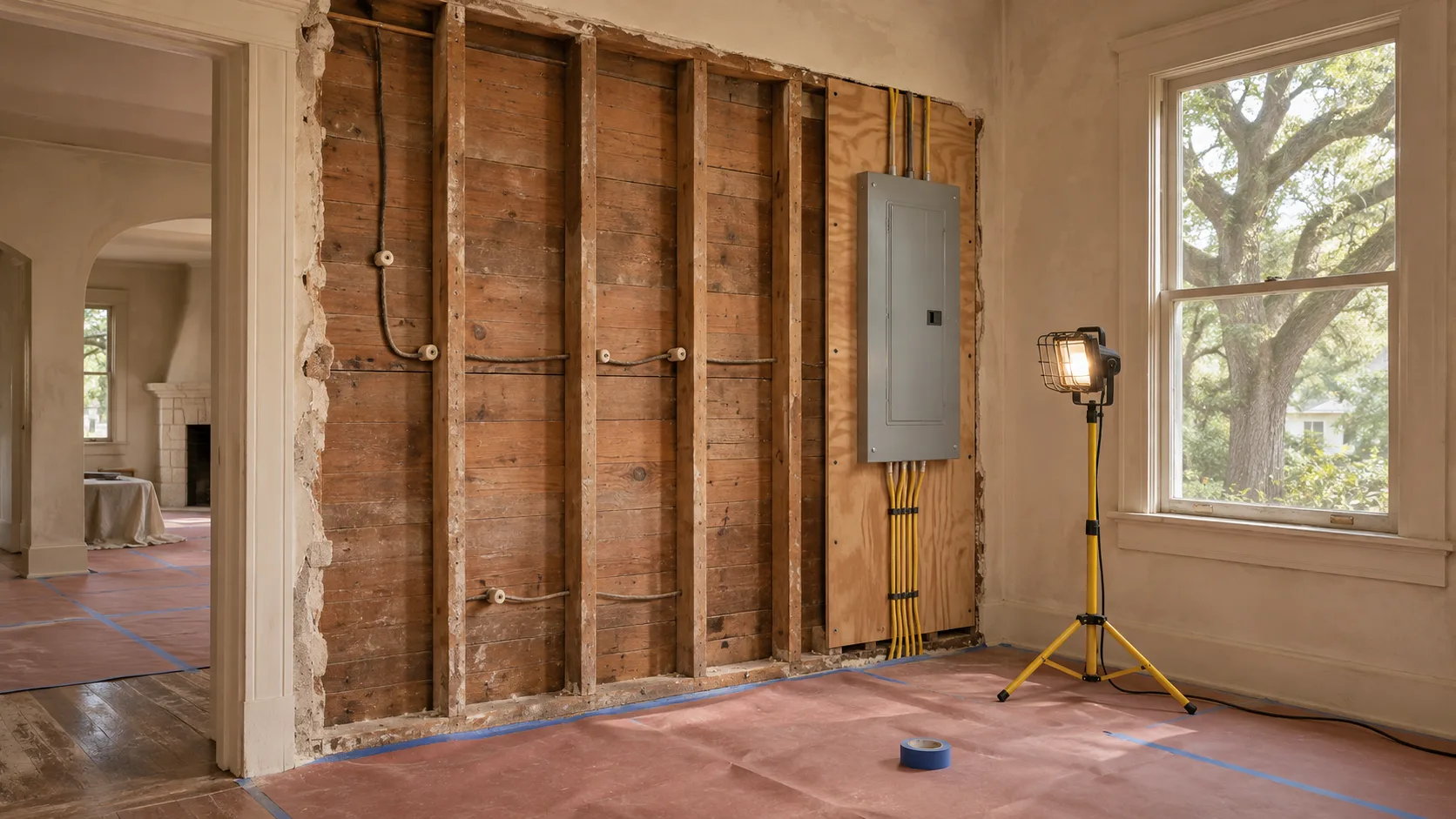
Before you buy or remodel a Houston house built before 1980, find out which of 4 wiring situations you have: original knob-and-tube from the 1920s to 1940s, ungrounded cloth or early plastic cable from the 1950s and 60s, aluminum branch wiring from roughly 1965 to 1973, or modern copper with an old panel. Only the first needs a true whole-house rewire as a rule. The other 3 are usually fixed with targeted work, and the panel is where most of the money and most of the safety sits.
That sorting matters because a home inspector's "outdated electrical" line item covers all 4, and the repair scope for each runs from an afternoon to a month with the walls open.
Here is how I sort them.
What does knob-and-tube look like, and is it automatically dangerous?
Knob-and-tube is single-conductor wire, rubber or cloth insulated, run through the framing on porcelain knobs and through porcelain tubes where it crosses a stud or joist. Hot and neutral run as separate wires a few inches apart. There is no ground wire. It was standard in Houston until roughly the 1940s, so you find it in the Heights, Woodland Heights, Montrose, Norhill and the older parts of Bellaire and West University.
It is not dangerous because it is old. It was designed to shed heat into open air, and in a wall cavity or crawlspace that stayed empty, much of it is still working after 80 years. What kills it is what people did to the house afterward.
- Insulation packed around it. Blown cellulose or spray foam buried over the wires removes the air they relied on to cool. Most insurers and most electricians treat knob-and-tube covered by insulation as a hard stop.
- Splices by non-electricians. A century of homeowners twisting wire together and wrapping it in tape, or tapping a new lamp onto a branch circuit that was sized for 2 bulbs. The original wire is rarely the problem. The additions are.
- Heat damage in attics. Houston attics run well above outdoor air temperature in summer. Rubber insulation that has baked for 80 summers goes brittle and flakes off the conductor when disturbed, and you find that out the first time someone moves it.
- Cut and abandoned runs. Remodels leave dead wire in the walls, and some of it is still live at a junction nobody labelled.
Here is the concession. A knob-and-tube circuit that has never been insulated over, never been overloaded and never been spliced by an amateur can be safe. A careful electrician can tell you which circuits those are. Many electricians will still not warrant it, and that is the more useful fact for a buyer.
Why does knob-and-tube matter for a remodel and not just a purchase?
Because modern work touches the walls and covers the wires.
Three things in a typical Houston remodel make old wiring everyone's problem:
- Insulation. A spray foam attic is common in the region, and I have written about spray foam in an existing Houston attic. Any wire in that attic is wire you are about to bury. Knob-and-tube comes out first or the foam does not go on.
- Load. A kitchen with an induction range, an EV charger in the garage and a new heat pump on the same 100-amp panel is a different house than the one the wiring was sized for. The panel and the feeder get replaced before the circuits do, and the circuit count gets recalculated from what the house will actually run.
- Opening walls. The moment a plaster wall is cut open, the wiring inside is no longer something you can leave alone. Inspectors who see old wire in an open wall will not sign off a permit scope that closes it back up untouched.
A 1930s house with a clean, open crawlspace is the easy case. Pier-and-beam means you can run new cable under the floor and up through the bottom plates without opening every wall. I made the case for pier-and-beam access on plumbing, and electrical is the same argument. A slab house with plaster walls and a flat roof is the hard case, and a full rewire there is mostly a drywall and plaster repair bill.
Is aluminum wiring a problem in a Houston house?
Yes, in a specific band of houses, and the problem is almost always at the connections rather than in the wire itself.
During a copper shortage in the mid-1960s to early 1970s, some builders wired branch circuits with aluminum. Aluminum expands and contracts more than copper and oxidizes, so over years the connections at outlets, switches and light fixtures loosen and heat up. The failures cluster at devices that were rated only for copper.
If your house was built or added onto between about 1965 and 1973, which covers a lot of Bellaire, Meyerland, Spring Branch and Sharpstown, look for aluminum branch wiring. The cable jacket will usually say "AL" or "ALUMINUM", and an electrician can confirm it in 10 minutes at the panel.
The fixes, from lightest to heaviest:
- COPALUM crimp connectors or approved pigtails at every connection. This is a repair, not a rewire, and it needs an electrician who does this specific work.
- Devices rated for aluminum replacing the old switches and outlets.
- Replacement with copper where walls are open anyway.
The one move I would not accept is "we'll swap the outlets with ordinary ones." Ordinary devices on aluminum wire are how you get the problem you were trying to fix.
What if the wiring is fine and the panel is the problem?
This is the most common case, and the one buyers underestimate.
An electrical panel from the 1970s or earlier can be a perfectly working piece of equipment that cannot do what a modern house asks of it. Three versions come up:
- 60-amp or 100-amp service on a house now running 2 air conditioners, an electric dryer and a range. It trips because it is undersized. Upgrading to 200 amps is common, and in Houston it usually involves the electric utility's meter and the street connection, not just the box in the garage.
- Panels that inspectors flag by brand. Federal Pacific and Zinsco panels are two that many inspectors write up on sight, because their breakers have a documented history of not tripping when they should. Replacing them is rarely controversial.
- Panels that took on water. A house that flooded during Harvey or a later event may have a panel low on the wall that went underwater. Flood-damaged electrical equipment is generally something you replace rather than dry out and keep. Check the date of any post-flood repairs and ask who did them.
A new panel also gives you room. A 40-space panel with 14 circuits used leaves room for the kitchen, the garage and the EV charger. A 20-space panel full to the last slot does not.
What a custom home's electrical plan should include is a useful reference for how many circuits and how much capacity a house like yours should be planned around. The same logic applies when you are upgrading an old house, with the added problem that you are fitting it around what already exists.
Who is allowed to do this work in Texas?
Electrical work is licensed at the state level. TDLR, the Texas Department of Licensing and Regulation, licenses electricians, and a house rewire is a job for a licensed master or journeyman working under a master. Ask to see the license and check it against TDLR's lookup.
What varies is the city. Each Houston-area jurisdiction runs its own permit and inspection process, and which one governs your lot decides the whole procedure. Which jurisdiction governs your lot goes through how to find out. Permit fees and turnaround change, so confirm current figures with the jurisdiction before you set a schedule rather than trusting an old quote.
Two things to hold the electrician to:
- A permit pulled in their name or yours, with an inspection. An unpermitted rewire shows up on the next sale as a disclosure problem and, sometimes, an insurance one.
- A written scope that says which circuits are being replaced, which are being kept, and what happens to the abandoned wire in the walls.
Compare it against what a contractor contract should say about changes, because a rewire is where change orders come from. Nobody knows what is behind the plaster until it is opened.
Does a Houston historic district limit electrical work?
Not directly. The Certificate of Appropriateness process in the City of Houston reviews exterior work. A rewire done inside the walls is generally an interior matter. The exceptions are the visible parts: a new meter location, a service mast, a conduit run up the front of the house, or a new panel on a street-facing wall.
Those are things the historic district review can care about. The practical advice is to put the service entrance where the plans show it, tell the electrician it is a historic district house, and let the electrician and the district office sort out the mast location before the old one comes off.
What will insurance and the inspector say?
Both are worth calling before the electrician.
Some insurers decline or surcharge houses with active knob-and-tube or aluminum branch wiring, and some require a licensed electrician's letter or a completed upgrade within a set period of closing. This differs by company and changes, so ask your agent for the actual underwriting rule in writing. It is a short call that can save a closing.
A home inspector is not an electrician. A good one will tell you what they see at the panel and in the attic, and say "evaluate by a licensed electrician" when they see old wiring. Treat that line as an instruction, not a boilerplate. Get the electrician through the house before the option period ends, not after.
How do I decide between rewiring and working around it?
My own rule, which not every electrician or builder will share.
- Walls are going to be open anyway: rewire the whole floor you are opening. The marginal cost of replacing wire while the plaster is off is a small part of the cost of the plaster.
- Walls are staying closed and you are not adding load: a new panel, targeted replacement of any circuit that is spliced, overloaded or insulated over, and arc-fault or GFCI protection where the adopted code calls for it. Check the code edition the jurisdiction currently enforces rather than assuming.
- Aluminum in the walls: repair at the connections is a legitimate answer, and a full rewire is the one that ends the discussion.
- Knob-and-tube you plan to insulate over: replace it. This is the only answer I give without caveats.
Then go through the electrician's number the way you would any allowance in a bid. If the number is a single line that says "rewire, $X," it is a placeholder. A real one lists the panel, the circuits, the patching and who fixes the plaster.
When you are ready to talk to designers about the rest of the house, our register of Houston architecture firms lists practices by area, and the cost calculator gives a first rough figure to test a remodel budget against.