Topic: Hiring
Published: 4 Nov 2026
Fixed-price or cost-plus: which contract fits a Houston custom home
A fixed-price contract is only as fixed as your drawings. Cost-plus is only as safe as your cap and your right to audit. For a Houston custom home with a complete drawing set and a soils report, I pick fixed-price. For a house that is still being designed, I pick cost-plus with a guaranteed maximum. Here is how to decide and what each contract needs to say.
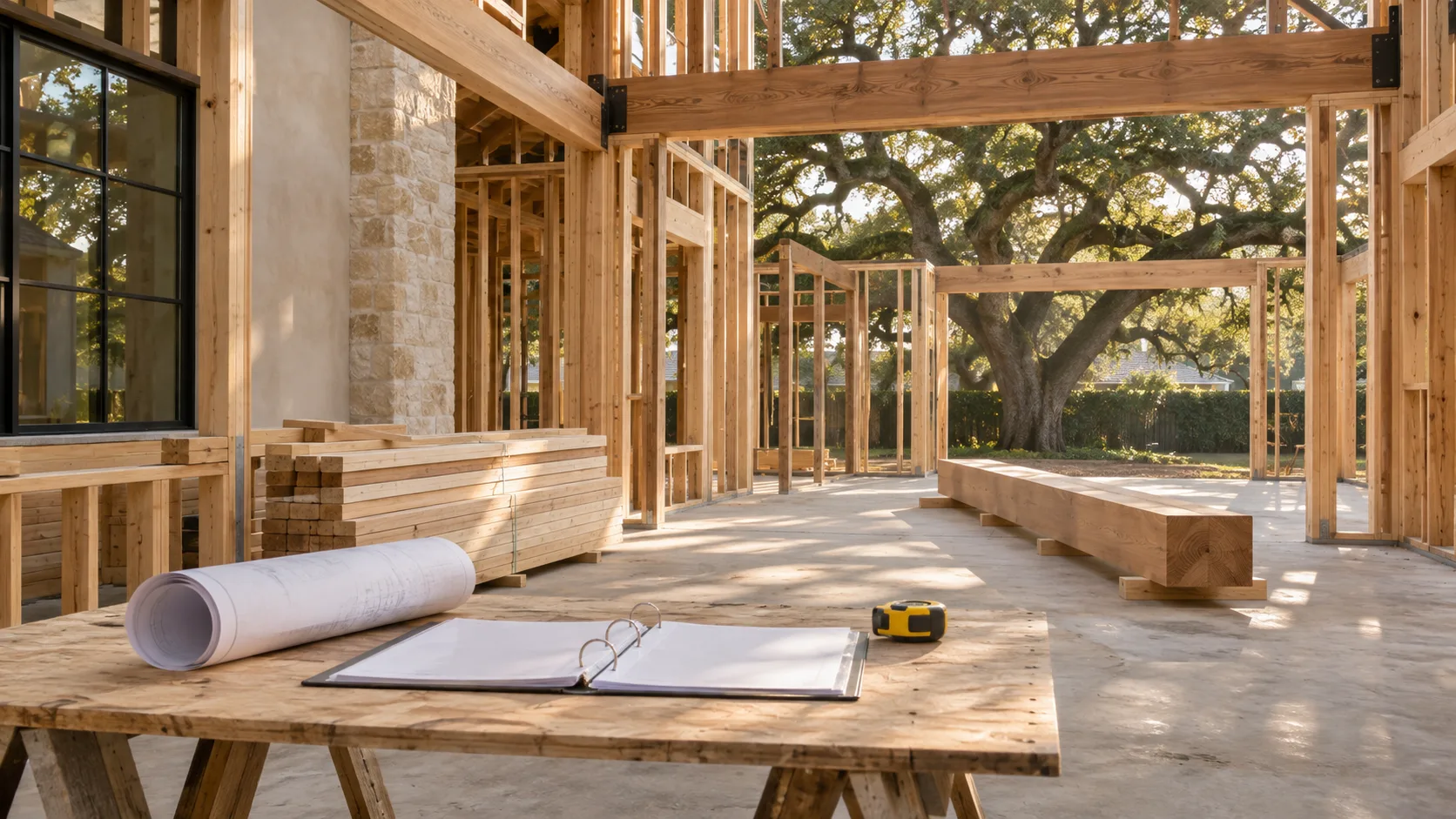
For a Houston custom home, I would sign a fixed-price contract when the drawings are complete and the soils report is in hand, and a cost-plus contract with a guaranteed maximum price when the design is still moving. A fixed price protects you only to the extent the drawings define what you are buying. Cost-plus protects you only to the extent the contract gives you a cap, a fee that is not a percentage of whatever the house ends up costing, and the right to see every invoice.
Most owners ask the wrong question. They ask which contract is cheaper. Neither is, by itself. The contract decides who carries the risk of the things nobody knew when the paper was signed, and on gumbo clay in a flood-mapped city, there are always some.
What is the difference between fixed-price and cost-plus?
A fixed-price (also called lump-sum) contract says: build this house, as shown on these drawings and described in these specifications, for $X. The builder prices the whole job up front and carries the risk of being wrong. If lumber jumps or the framing takes 3 weeks longer than estimated, that is the builder's problem. If you change your mind or the drawings turn out to omit something, that is a change order, priced by the builder at the moment you have the least leverage.
A cost-plus contract says: you pay what the work actually costs, plus a fee. The fee is either a fixed dollar amount or a percentage of cost. You carry the risk of the price. The builder carries the risk of nothing except being fired.
A guaranteed maximum price (GMP) sits between them. It is cost-plus with a ceiling. The builder bills actual costs plus the fee, but the total cannot pass the cap without a signed change order. Savings below the cap are usually split by a formula in the contract, or returned to you, or sometimes kept by the builder, and which one it is matters more than owners realize.
Why is a fixed price only as fixed as the drawings?
Because the builder can only price what is shown. Walk through how a fixed-price bid is actually made. The builder takes your drawings and specifications, sends them to 20 or 30 subcontractors and suppliers, collects numbers, and adds overhead and profit. Wherever the drawings say "by owner" or "TBD" or "per manufacturer," the builder either carries an allowance or leaves it out of the number.
I covered the allowance problem in detail in why the lowest bid is often the least finished. The short version is that a fixed-price contract with 14 allowance lines is not a fixed price. It is a fixed price for the shell and a variable price for everything you can see. Owners find this out in month 8, when the tile selection comes in at $19,000 against a $9,000 allowance and the builder points, correctly, at the contract.
The practical test is this: before you ask for fixed-price bids, ask your architect whether the set is complete enough to bid without questions. A permit set is not that. A permit set shows the city that the house meets code. A construction set shows a builder what to put where. The difference is covered in what is in an architect's drawing set, and Modern Acre Studio's breakdown of a complete permit and construction set, phase by phase shows what a bid-ready package contains. If the set has gaps, a fixed-price bid will either come back padded with contingency or come back low and fill the gaps later through change orders. You choose which.
Why does Houston make this harder than most places?
Three local facts push risk into the contract that you would not see on a house in, say, a rock-bottomed Hill Country lot.
First, the ground. Houston sits on expansive clay, and the foundation is a design decision that depends on a geotechnical report. If the report is not done before bidding, the foundation is priced on a guess. Builders know that guess is probably light, so they either pad it or bid it low and write in a clause that lets them revisit the price once the soil boring comes back. Either way you have not bought a fixed price. I walked through what the report actually says in how to read a geotechnical report for a Houston house.
Second, the survey and the elevation. A finished floor that has to rise 14 inches because of the floodplain moves the foundation, the stairs, the stem walls and the grading, and a bid built on a closing survey will not include any of it. The survey you actually need comes before the drawings, and the drawings come before the bids.
Third, the lack of a state licence. Texas does not license residential general contractors, which means nothing in state law establishes a baseline of financial capacity or insurance for the person you are signing with. What to check when Texas does not license general contractors is its own piece. For this decision the relevant point is that a fixed-price contract signed with a thinly capitalized builder transfers risk on paper only. A builder who has underbid the job and cannot cover the loss does not eat it. They slow down, they substitute, or they stop. The risk was never really theirs to carry.
When does cost-plus make sense?
When the design is not finished, and you know it. A house where you are still deciding between 2 stories and 1, or where the site is unusual and the structure will not be resolved until the engineer has run numbers, cannot be bid at a fixed price in any honest way. Asking for one produces padded numbers and a fight at the first change.
Cost-plus also makes sense when you want the builder involved during design. A builder on a cost-plus or GMP preconstruction agreement can price the structure options in week 3, tell you that the cantilevered corner adds a steel beam and $22,000, and let you decide before the drawings are issued. That conversation is worth money. It is also the argument for hiring the builder early, and the best reason I know to accept the less comfortable contract form.
Here is the concession, because there is one. Cost-plus works when the owner is paying attention. You have to read the monthly cost reports, question the line that says "miscellaneous labor," and have somebody who understands construction compare invoices to the work in place. An owner who is busy, travelling, or simply uninterested in the details is a poor candidate for cost-plus no matter how trustworthy the builder is. A fixed price is, among other things, a way to avoid supervising.
What does a good cost-plus contract include?
Not every one that uses the label deserves it. Before signing, look for these:
- A fixed fee, or a fee that falls as a percentage when costs rise. A percentage fee on actual cost pays the builder more when the house costs more. That does not make a builder dishonest. It means the incentive points the wrong way, and you are depending on character alone.
- A cap. A guaranteed maximum price, with a defined list of what can raise it. "Owner-directed changes" is a fair reason. "Unforeseen conditions" needs a definition tight enough that rain on a Houston job site does not qualify.
- Audit rights. You, or someone you name, can see every subcontractor invoice, every supplier bill and the payroll allocation behind labor charges. If the builder's own staff are billed to your job, the contract should say at what rate and for which tasks.
- Defined reimbursable costs. What counts as a cost to the job and what is overhead the fee is meant to cover: the builder's truck, their office, the project manager's salary. Contracts that leave this vague generate the most disputes.
- A savings clause. If the house comes in under the cap, who benefits. Splitting 50/50 or returning savings to you are both common. Keeping them all is how a GMP quietly becomes a fixed price with a bonus.
- Payment tied to the work in place. Draws follow percent complete as verified by someone other than the builder, with lien waivers from the builder and the major subs at each draw.
What should a fixed-price contract include?
The same discipline, from the other side.
- The drawings and specifications listed by sheet number and date. The contract price is for this set, not "the plans." When the set is revised, the change is documented, not assumed.
- Allowances limited and defined. Each one states whether it covers material only or material, labor and trim, and whether overages carry markup. Move as much as you can out of allowances before signing.
- A change-order procedure with a pricing method. Written approval before work starts, a stated markup on changes, and a rule that unpriced changes do not proceed on a handshake.
- A schedule with consequences. A completion date means little without a stated remedy. Some owners use liquidated damages per day of delay. Builders resist this, and the negotiation tells you something about how confident they are in their own schedule.
- Retainage. A percentage withheld from each draw and released after punch-list completion. Ten percent is a common starting point; negotiate it. Hold the last piece until the punch list is genuinely closed, not merely listed.
Does the contract type change who is responsible for mistakes?
Less than owners hope. Under a fixed price, a builder who misreads the drawings and installs the wrong thing should fix it at their own cost. Under cost-plus, the same mistake can get billed to you unless the contract says otherwise. That is a clause worth reading twice: rework caused by the builder's error should not be a reimbursable cost.
What the contract does not change is the quality of the supervision. Whichever form you use, someone has to walk the job during construction, compare what is in the wall to what is on the drawings, and review each draw before you pay it. That can be your architect, an owner's representative, or you. It cannot be nobody. The cheapest version of "nobody" is trusting the builder to inspect their own work, and I have rarely seen that end well on either contract form.
Do Texas rules add anything I should know about?
A few, and I am not a lawyer, so treat this as a list of things to bring to one. Texas has specific requirements for contracts on a homestead, including a written agreement signed before work begins, and the mechanic's lien rules give subcontractors and suppliers a path to a claim on your property if the builder does not pay them. That is why lien waivers at each draw matter, and why retainage matters. Texas also has a statutory process for construction-defect claims under the Residential Construction Liability Act, which requires written notice to the builder before a lawsuit. The deadlines, the notice requirements and the homestead formalities change, so have a Texas construction attorney read the contract before you sign it. The few hundred dollars that costs is small next to the size of the document.
So which one do I choose?
If I had a finished construction set, a soils report, a survey with elevations, and a builder whose financials I had checked, I would take the fixed price and spend my attention on the allowances and the change-order clause. If any of those four were missing, I would not pretend a fixed price existed. I would sign a GMP with audit rights and a fixed fee, hire the builder before the drawings were finished, and read the cost report every month.
The one combination to avoid is the one that feels safest: a fixed price signed on incomplete drawings, because someone wants a number. It produces a number. It does not produce a house at that price. Houston owners learn this in the middle of construction, and by then the contract form is the least of the options still open.