Topic: Construction
Published: 30 Oct 2026
A transferable foundation warranty doesn't mean the foundation is fixed: reading the repair paperwork on a Houston house
A recent foundation repair with a transferable lifetime warranty tells you a company pushed piers under part of the house, not that the slab is stable. Here is what the paperwork on a Houston house actually proves, what it leaves out, and the 4 documents worth asking for before the option period ends.
A foundation repair with a transferable lifetime warranty means one thing for certain: a company pushed piers under some part of the house and will honor a document about those piers. It does not mean the slab is level, the cause of the movement was found, or the next owner is protected from whatever moves next.
Houston buyers read that warranty as the end of the story. The seller's agent reads it that way too, which is why it shows up in the listing. I read it as the first page of a file, and the file is usually thin.
What the warranty covers, and what it quietly leaves out
Open the paper itself. Not the glossy summary, the contract and the warranty terms behind it.
Most foundation repair warranties cover the piers the company installed, at the locations it installed them. Read that again. A house with 14 piers under the front and left side is warrantied at those 14 points. The back right corner, where nothing was done, is not covered, and a slab that was stabilized in one place often starts moving in another. Gumbo clay does not care which corner a salesman drew on the diagram.
Then look for the exclusions. These turn up again and again:
- Damage from plumbing leaks under the slab. This is the big one in Houston, because the original cast iron drain lines in houses from the 1960s and 70s are failing at an age when the foundation has already been repaired once.
- Drainage and grading problems on the lot, which the owner is responsible for.
- Cosmetic damage: cracked drywall, sticking doors, tile that has already broken.
- Settlement that is "within industry tolerance," a phrase worth asking about by name.
The transfer clause matters too. A transfer usually needs written notice within a window after closing, sometimes a fee, and sometimes an inspection by the company. Miss the window and the document you paid a premium for becomes a keepsake. I have seen buyers close in a hurry, put the warranty in a drawer, and discover 8 months later that it had expired in 60 days.
And a warranty is only as good as the company that wrote it. A lifetime warranty from a firm that has been in business for 30 years is worth something. The same document from a firm that opened in 2019 and rebranded twice is worth what the lawyer's letter costs you to send. Texas does not license foundation repair contractors the way it licenses electricians and plumbers, so there is no state board to complain to if the company vanishes. Confirm that against current rules before you rely on it, but plan as if it is true.
Why a repair does not prove the problem is solved
Think about what a pier does. Pressed concrete piers, the most common system on Houston slabs, are precast cylinders hydraulically driven down beside the foundation until the soil resists, then shimmed to lift the slab back toward level. They work on the idea that the deeper soil is stable even when the top few feet are not.
Often that is true. The clay in the upper 10 to 15 feet is the layer that breathes: it swells after a tropical storm and shrinks in a dry August. Piers that reach below the active zone ignore the breathing. That is the case for them, and it is a good one.
But a pier solves where the slab sits, not why it moved. If the movement came from a leaking supply line wetting one corner, a downspout dumping against the footing, or a live oak 12 feet from the wall pulling water out of the ground all summer, the piers hold the house while the cause keeps working. It may take 10 years, or the next 2011-style drought, to find out. The deep dive on how that clay behaves is in why Houston houses move, and the specific case of a big tree is in the piece on live oaks and foundations.
There is also the simple fact that piers are installed on a sales visit's diagram. Nobody cored the slab or tested the soil first. A company that typically prices by the pier has a mild interest in the diagram having a lot of piers. I do not say that to slander an industry that includes careful, honest crews. I say it because the party who prescribes the repair and the party who sells the repair are the same, and that is not how you would structure any other decision involving this much money.
Concession, and a real one: for many Houston houses, piers are exactly the right answer. A 1985 slab that dropped an inch at one corner after a drought, with a documented fix and 15 quiet years since, is a better bet than a never-repaired house of the same age with unknown movement. The repair is not the red flag. Missing evidence is the red flag.
The 4 documents worth asking for
Texas buyers have an option period in the standard contract, a short window they pay an option fee for, during which they can inspect and walk away. That window is when you ask for paper, not after closing. These are the 4 I would want.
1. The engineer's report that preceded the repair. If an independent structural engineer evaluated the house before the work, the report names the cause of movement and recommends a fix. If the only document is the repair company's own estimate, you are looking at a sales proposal, not a diagnosis. Neither is dishonest, but only one of them was written by someone with no stake in the answer.
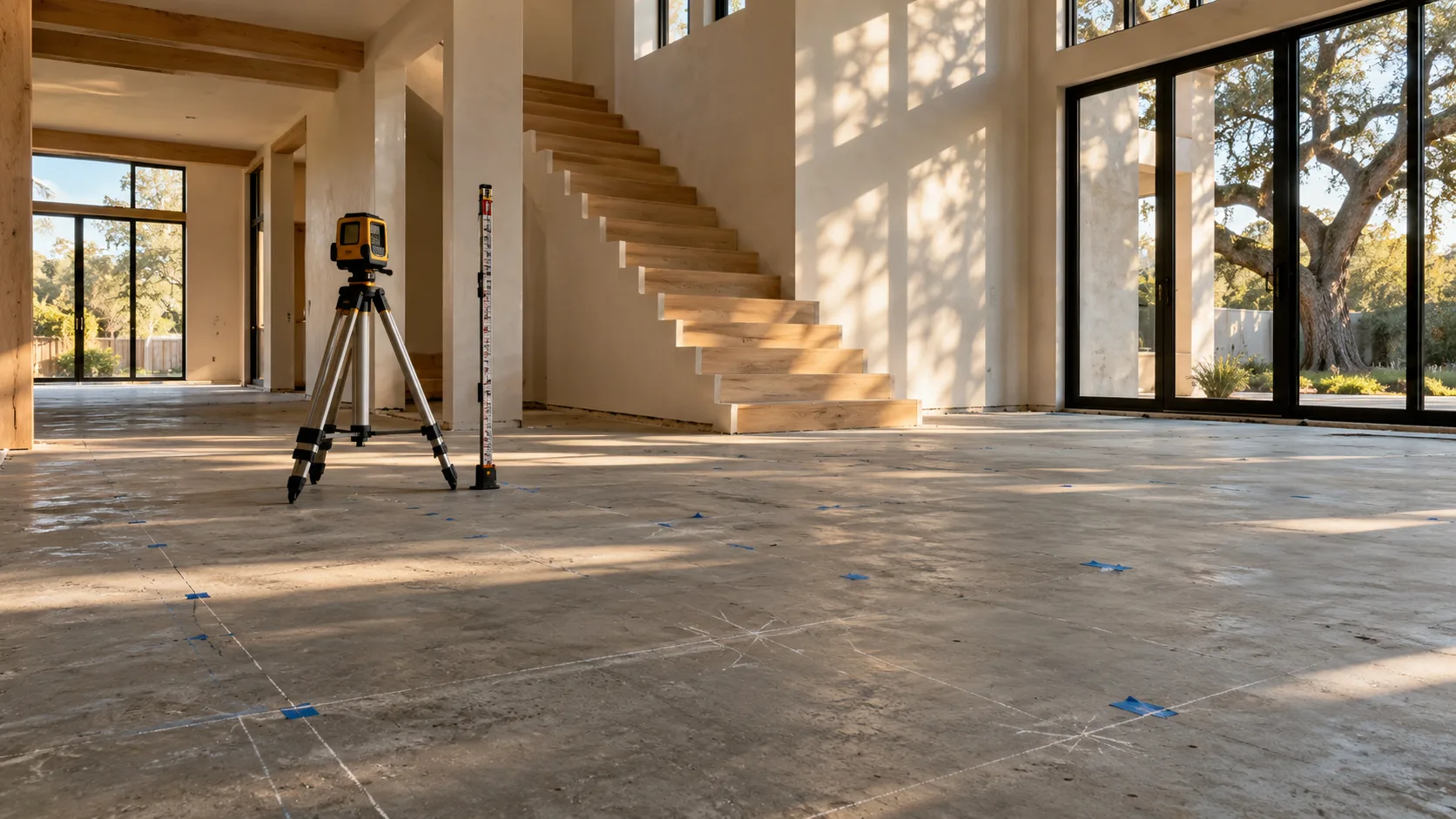
2. A floor elevation survey, before and after if you can get both. This is a set of readings, often taken with a digital manometer or a laser level, at 20 to 60 points across the floor, producing a map of high and low spots in inches. An after-repair survey shows what the piers actually achieved. A current survey shows whether the house has moved since. Compare the two. If the low corner has dropped another half inch since the repair, you have learned what the warranty's "within tolerance" language will say about it.
Industry guidance, including the Texas section of ASCE's guidelines for evaluating residential foundations, treats slope and deflection over distance as the measure rather than any single number. An engineer reading the map is worth more than a buyer squinting at one. Ask what the highest and lowest readings are and where they sit.
3. A plumbing test of the drain and supply lines. A hydrostatic test on the under-slab drain line, where the line is plugged and filled with water and watched for a drop, takes a plumber about an hour. It finds the leak that the repair company's warranty will not cover. If the house has cast iron drains from before the mid-1980s, I treat this test as close to mandatory. If a leak turns up, the foundation repair may have been a treatment for a symptom that is still active.
4. The warranty itself, with the transfer terms highlighted. Ask for the full contract, the pier locations, the date, the company's current contact information, and the transfer deadline. Then call the company yourself, using a number from its website and not one printed on the paper the seller handed you, and ask whether the warranty is active and transferable for this address.
What a good file looks like, and what a bad one looks like
A good file has an ending. An engineer's report said the northwest corner dropped because of a leaking supply line and shallow footing. The leak was repaired and the drain line was tested. Piers went in at the northwest corner. A post-repair survey shows the floor within a reasonable range. Six years later, the new buyer's survey matches it. Each document explains the one before.
A bad file has a shine on it and a hole in the middle. A glossy warranty. A diagram with a pier count and no engineer. Fresh paint on the ceiling cracks and sheetrock patches in a pattern that suggests the movement continued after the work. A seller who has lived there 4 years and says the previous owner "had it done." Nobody can say why.
Seller's disclosure is worth a read too. The Texas seller's disclosure notice asks about previous structural repairs, and a seller who checks "yes" has told you to go find the paperwork. A seller who checks "no" on a house with fresh pier shims in the yard has told you something else.
What it costs to find out, and what it costs not to
I will not quote prices here, because engineering and plumbing test fees move and vary by firm, and I would rather you call 3 and compare than take a number from me. Directionally: an engineer's evaluation, an elevation survey and a plumbing test together cost a small fraction of a single pier job. A pier job on a mid-sized Houston slab is often a repair measured in tens of thousands of dollars; get current quotes. Spending the small amount to find out whether you are buying the second one is not a hard decision.
The harder decision is what to do with a bad answer. A buyer can ask the seller to repair, ask for a price reduction, or leave. Which is right depends on the numbers, and on how much you like the house. On a 1940s pier-and-beam bungalow in the Heights the repair is a different animal, since access underneath makes releveling cheaper and more reversible, which is why I suggest reading the pier-and-beam piece first if that is what you are looking at.
Questions people ask about foundation repair on a house they are buying
Is a house with a prior foundation repair a bad buy?
Not by itself. Most Houston houses over 25 years old have moved somewhere, and a documented repair with a known cause and a stable record since is often better than an unrepaired house with unknown movement. What makes it a bad buy is a repair with no explanation, no survey and no plumbing test.
Does a lifetime foundation warranty transfer to me automatically?
Often not. Many require written notice to the company within a set number of days of closing, and some charge a transfer fee or require a re-inspection. Read the transfer clause before you close and put the deadline on your calendar.
Should the foundation inspection come from the repair company?
I would not rely on one. A company that sells the repair has a stake in how it describes the problem. An independent licensed structural engineer who does not sell repair work is the cleaner choice, and the report belongs in your file whatever the verdict.
Can I tell from the outside whether a slab has been repaired?
Sometimes. Look along the perimeter for small square or round patches in the concrete or soil where piers were set, fresh caulk or paint on exterior masonry cracks, and diagonal drywall patches near door corners inside. None of that proves the repair was done correctly. It tells you where to ask questions.
What if the seller's repair was done years ago and no paperwork exists?
Then treat the house as if it had never been repaired for purposes of risk, and spend what it takes to get a current elevation survey and a plumbing test. Without records you can only evaluate the present, so measure it.
If you are building new, not buying old
The reverse of everything above is also useful. A new custom house on a lot with a proper geotechnical report and drainage designed from the first sketch starts life with the file a buyer 20 years later would love to find. If the lot has a hard-to-manage slope or the downspouts have nowhere to go, how a lot is graded to shed water is where I would start, because most of what ends up in foundation paperwork began as water in the wrong place.
And if you are comparing architects or builders for that project, the questions in what to ask before signing cover who owns the foundation decisions when something goes sideways.